When your furnace quits on a brutally cold Central Minnesota night, it’s easy to assume the worst. But before you panic and call for a service, take a deep breath. A surprising number of "emergencies" I see are caused by something incredibly simple.
Running through a few quick checks yourself can often solve the problem in minutes, saving you a service fee and getting your heat back on right away.
Your First Diagnostic Checks for a Faulty Furnace
That sinking feeling when the house goes quiet and the temperature starts to drop is all too familiar for us Minnesotans. The good news? It’s often not a catastrophic failure. More times than not, it's a simple, overlooked issue that you can spot and fix yourself.
Let's walk through the first places you should look. These are the exact same things a technician would check the moment they walk in your door.
Start With The Simplest Solutions
Before you even touch the furnace, head to the thermostat. It’s the brain of your entire heating system, and a wrong setting will stop everything in its tracks.
First, make sure it’s actually set to "heat" mode. It sounds obvious, but during those weird fall or spring weeks where the temperature swings, it’s easy to forget it was switched to "cool" or "off." Next, turn the temperature up at least five degrees higher than the current room temperature. This forces the thermostat to send a clear "turn on" signal to the furnace.
If the thermostat is set correctly, your next stop is the electrical panel. A tripped breaker is another common culprit. Find the breaker labeled "Furnace," "HVAC," or "Air Handler." If it's in the middle or "off" position, flip it all the way off and then firmly back on to reset it.
CRITICAL SAFETY NOTE: If the breaker trips again right away, do not reset it again. This is a clear sign of an electrical problem that needs a professional.
The Most Common Culprit: The Air Filter
If I had to bet on what’s causing your furnace issue without even seeing it, my money would be on a dirty air filter. A clogged filter is, without a doubt, the #1 reason for furnace service calls, especially here in Central Minnesota.
When your filter is packed with dust, pet dander, and other gunk, it chokes the system. The furnace can't pull in enough air, forcing the blower motor to work way too hard. This can cause the unit to overheat, which triggers a safety switch that shuts the whole thing down. This leads to that frustrating cycle where the furnace runs for a few minutes and then quits, over and over again.
You can learn more about how a dirty filter causes these and other common furnace problems, but the fix is simple: check it and change it.
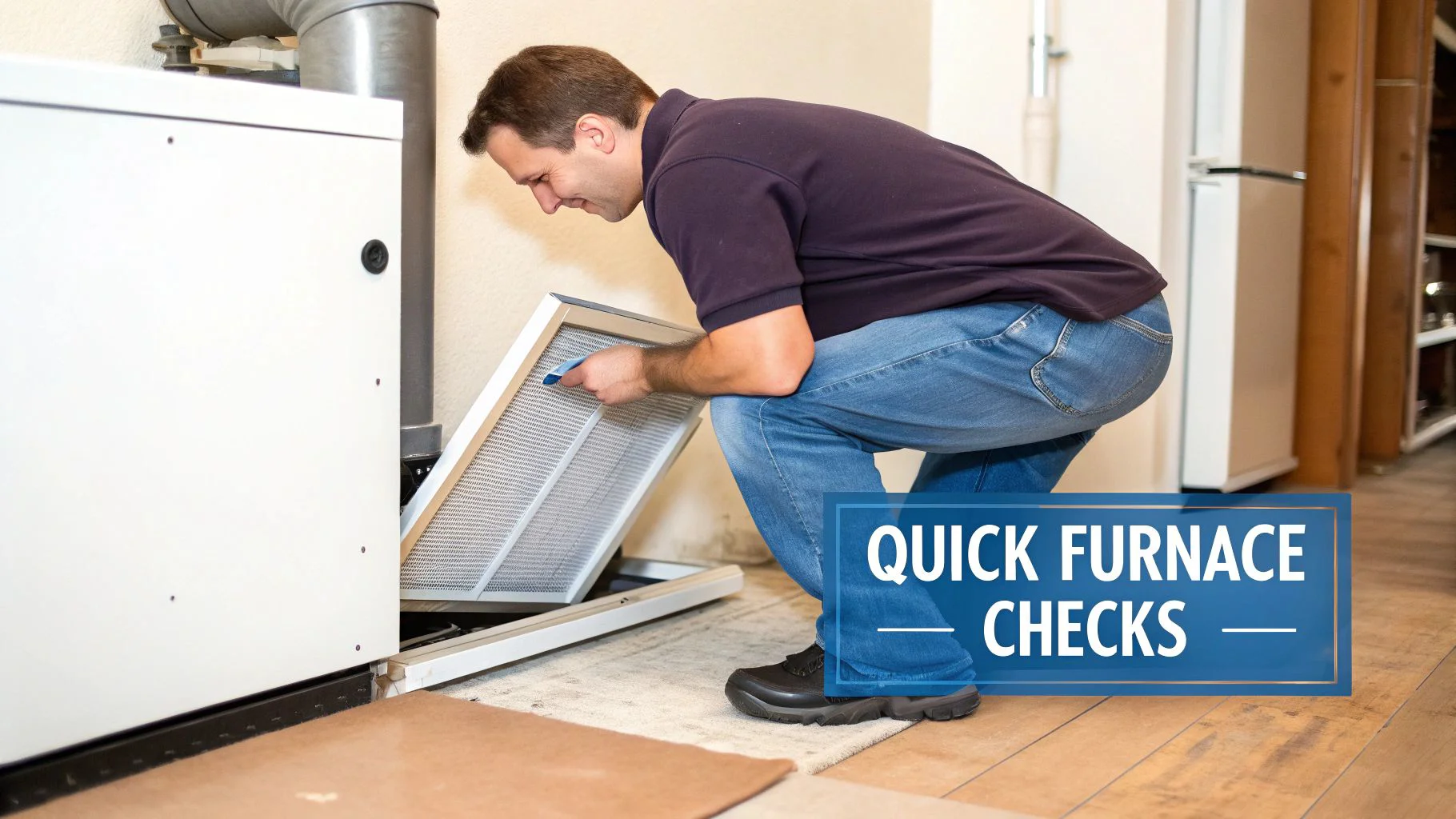
Locate the filter slot—it’s usually a thin metal door on the side of the furnace where the large ductwork enters. Slide the old one out and hold it up to a light. Can't see the light through it? It's toast. Pop a new one in.
Quick Furnace Diagnostic Checklist
To make things even easier, here’s a quick table to match what you’re seeing with the first thing you should check. Think of it as a cheat sheet for those initial troubleshooting steps.
| Symptom You're Experiencing | First Thing to Check | Potential Simple Fix |
|---|---|---|
| Furnace Won't Turn On At All | Thermostat settings and the main circuit breaker. | Set to 'heat' and turn the temp up, or reset the tripped breaker. |
| Furnace Runs, But No Heat | The air filter's condition. | Replace a dirty or clogged filter to restore proper airflow. |
| Short-Cycling (On and Off) | Air filter and blocked registers/vents. | Replace the filter and make sure furniture isn't blocking airflow. |
Running through these basics first will handle a huge percentage of furnace issues. If you’ve checked all these things and the heat still isn’t on, then it’s time to call in a professional.
Decoding Strange Furnace Noises and Smells
Your furnace rarely ever dies in silence. Long before it gives up for good, it starts sending out little warning shots—clunks, whines, and strange smells that are easy to ignore until you have no heat. Learning to interpret these clues is one of the most important parts of diagnosing gas furnace problems. It’s how you can tell the difference between a minor quirk and a serious safety hazard.
Think of it as learning your furnace's language. One of the most common—and alarming—sounds is a loud banging or popping noise right when the heat kicks on. This isn't just your house settling. It's often a sign of delayed ignition, where gas builds up in the combustion chamber for a few extra seconds before whoomph—it finally ignites. While that mini-explosion is startling, the cause is usually just dirty burners that need a good professional cleaning.
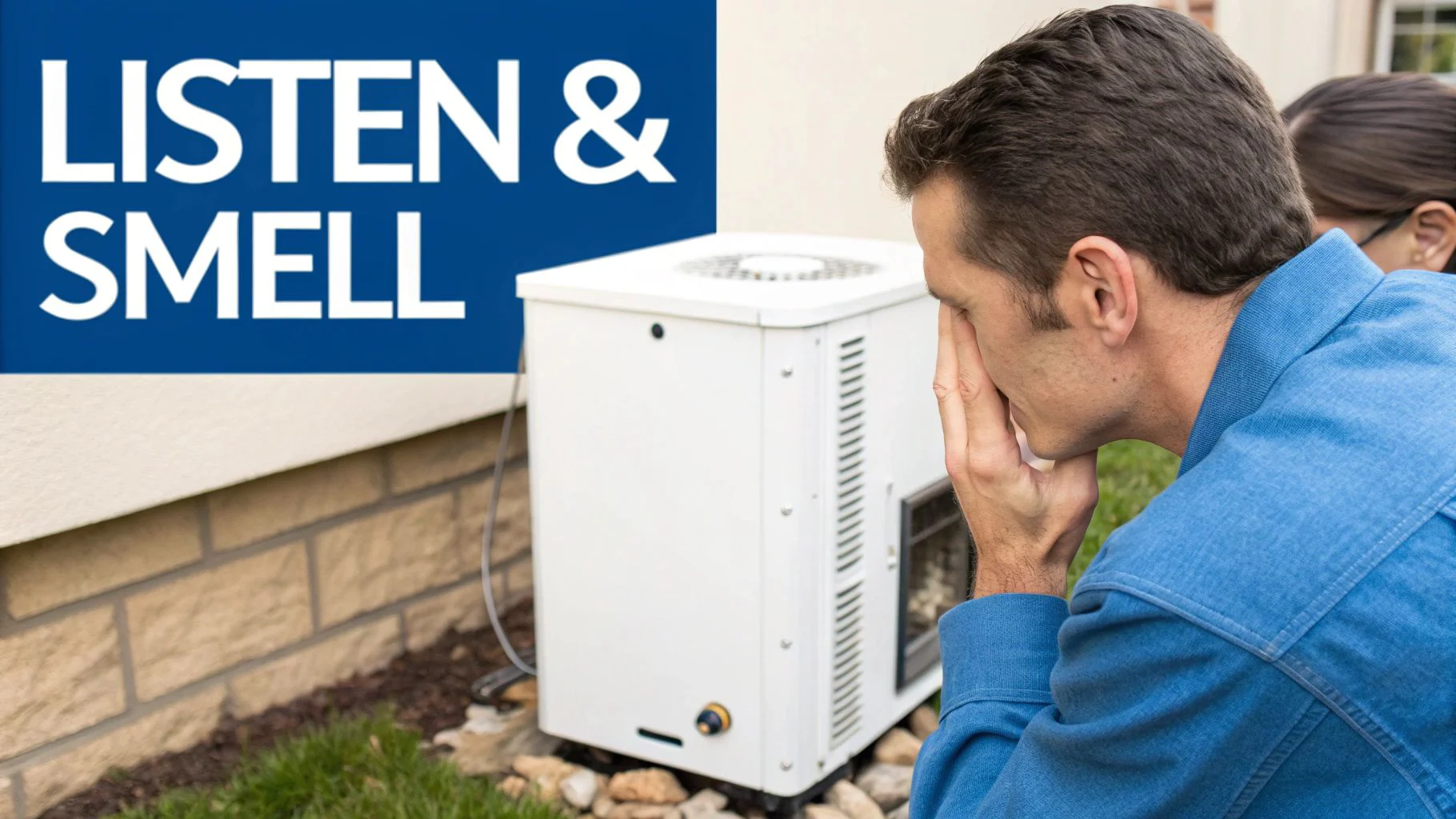
Interpreting Common Furnace Sounds
Other noises usually point to mechanical problems, typically with the blower system responsible for moving warm air through your home. Knowing what to listen for can give you a pretty good idea of what's going on.
- High-Pitched Squealing or Whining: That persistent, piercing sound almost always points back to the blower motor. It could be something simple like a worn-out belt that needs replacing, or it could be a more serious issue like failing motor bearings.
- Grinding or Scraping: If you hear a metallic grinding noise, that's a red flag. It often means the blower wheel has come loose from its mount or the motor bearings are completely shot. Shut the system down immediately to stop it from tearing itself apart.
- Rattling: A constant rattle might be something as simple as a loose access panel or a few screws that have vibrated loose over the years. But don't dismiss it—it can also be a sign of a more significant internal component shaking around.
Expert Tip: Never ignore a new noise. A sound that appears suddenly and sticks around is your furnace’s way of screaming for help. Catching it early can often mean the difference between a simple repair and a complete system breakdown.
What That Smell Is Trying to Tell You
Just as important as the sounds are the smells coming from your vents. Some are totally normal, but others are urgent warnings that demand immediate action. That dusty, slightly burnt odor you smell the first couple of times you fire up the heat for the season? That's perfectly fine. It’s just dust burning off the heat exchanger after a long summer off.
But if that burning smell hangs around for days, or if it smells more like melting plastic or hot wires, shut your furnace off at the breaker. You could be dealing with an overheating motor or an electrical short.
The one smell you must never, ever ignore is the scent of rotten eggs or sulfur. Natural gas is actually odorless, so utility companies add a chemical called mercaptan to give it that unmistakable smell for safety. If you smell it, you have a gas leak.
Don't touch any light switches, unplug anything, or use your phone inside. Get everyone out of the house immediately. Once you're a safe distance away, call your gas company's emergency line. This isn't a suggestion; it's a critical safety procedure.
Solving Common Ignition and Pilot Light Issues
So, your furnace blower is running, but the air pushing through your vents is stubbornly cold. This is a classic sign that points away from the thermostat and straight toward the furnace's ignition system. It's trying to work, but the most critical part—creating the fire—isn't happening.
These days, you won't find the old-school, always-on pilot lights that your grandparents' furnace had. Modern systems rely on electronic ignition for both safety and efficiency, and they usually come in one of two flavors.
Hot Surface Igniters vs. Intermittent Pilots
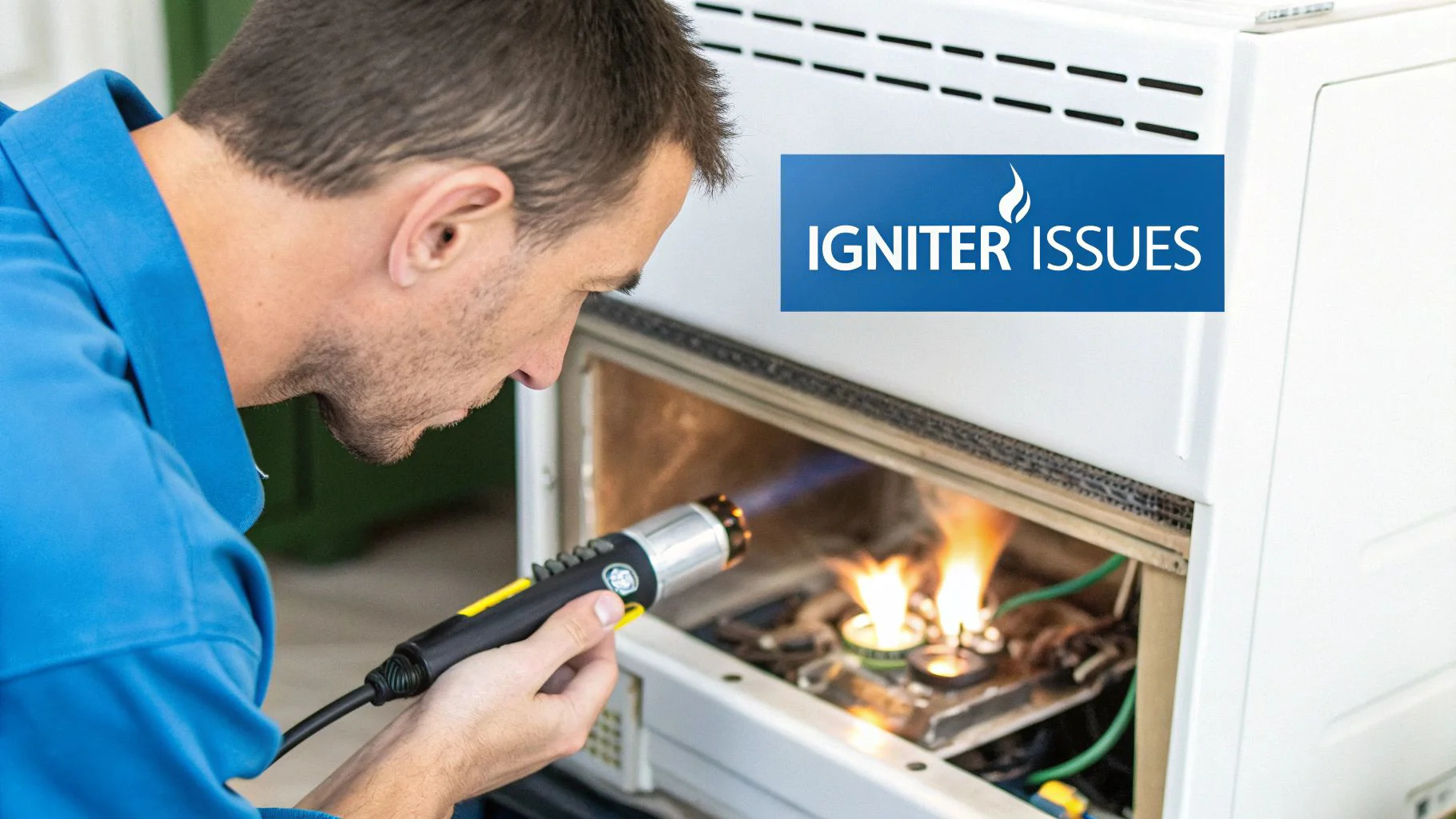
Most high-efficiency furnaces use what’s called a hot surface igniter (HSI). Think of it as a super-powered lightbulb filament. This small ceramic piece glows red-hot—often hitting over 2,000°F—to light the gas as soon as the furnace calls for heat. You’ll hear a click, maybe a low hum, and then the burners should roar to life.
The other type is an intermittent pilot system. It’s a bit different. It uses an electric spark to light a small pilot flame first, and that flame is then used to ignite the main burners.
A tell-tale sign of a failing HSI is when you hear the furnace click and try to start, but the burners never actually catch fire. After a few attempts, the system will lock itself out as a safety precaution. HSIs are surprisingly fragile. The constant cycle of extreme heating and cooling eventually causes tiny hairline cracks, leading to failure.
The Role of the Flame Sensor
Another common troublemaker is the flame sensor. This isn't part of the ignition process itself; it's a safety device. It's just a thin metal rod that sits right in the path of the flame.
Its entire job is to confirm that the burners have successfully lit. If it can't "see" a flame, it signals the control board to immediately shut off the gas. This is a crucial safety feature that prevents your furnace from pumping unburned gas into your home.
Over time, this little rod gets coated in carbon buildup, which acts like an insulator. The sensor can no longer detect the heat from the flame, so it mistakenly tells the furnace there's no fire. The result? Your furnace will fire up for just a few seconds and then shut right back down.
While cleaning a flame sensor can sometimes be a DIY fix, it's a delicate component. If you'd like to learn more, check out our guide on how to locate the flame sensor on a furnace.
Figuring out why your furnace isn't working can save you from a cold night, but this next part is about something far more important: keeping your family safe. Some furnace problems go beyond simple inconvenience and become genuine, life-threatening dangers.
Knowing how to spot the signs of a natural gas leak or carbon monoxide exposure is the single most critical piece of furnace troubleshooting.
These are the two situations where you must stop whatever you're doing and take immediate action.
Identifying a Natural Gas Leak
That distinct "rotten egg" smell is the universal warning sign of a natural gas leak. Gas itself is odorless, so utility companies add a sulfuric chemical called mercaptan to make it detectable. If you catch even a faint whiff of it, you need to act fast.
Here's what you do—no exceptions:
- Don't touch anything electrical. No light switches, no appliances, not even your phone. The tiniest spark can ignite the gas in the air.
- Get everyone out of the house immediately. Leave the doors open on your way out to help air out the space.
- Call your gas company's emergency line. Make the call from a safe distance, like from your car down the street or a neighbor’s house.
A gas leak is never a "wait and see" problem. The only safe response is to call for professional help. The gas company will get there quickly to shut off the gas and find the source of the leak, making sure your home is safe before anyone thinks about repairs.
The Silent Threat of Carbon Monoxide
While a gas leak announces itself with a smell, carbon monoxide (CO) is much more sinister. It's completely odorless and invisible, which is why it's often called the "silent killer." CO is produced when your furnace isn't burning fuel correctly, usually because of a ventilation problem or a major component failure.
A cracked heat exchanger is one of the most dangerous gas furnace problems out there. It can silently leak carbon monoxide into your home. This gas is responsible for over 400 deaths in the U.S. every year and thousands of poisonings. The heat exchanger is what separates the toxic combustion gases from the air you breathe, and it can crack after years of expanding and contracting with heat. A flickering, yellow flame instead of a steady blue one is a classic warning sign.
Signs of a CO Problem
Since you can't see or smell carbon monoxide, you have to rely on other clues. Pay close attention to how you feel and what your furnace is doing.
Physical Symptoms of CO Exposure:
- Dull, persistent headaches
- Dizziness or feeling light-headed
- Nausea and vomiting
- General weakness and confusion
- Flu-like symptoms that seem to get better when you leave the house
Visual Furnace Warning Signs:
- Soot streaks or black stains on the furnace cabinet, especially near the burners.
- A flickering, lazy yellow or orange burner flame instead of a crisp, steady blue one.
- A lot of moisture or condensation on windows and walls near the furnace.
Your number one defense against this invisible threat is having working carbon monoxide detectors on every level of your home, especially near bedrooms. Test them every month and change the batteries on a regular schedule.
To make sure your home is fully protected, take a look at our guide on essential carbon monoxide safety tips for Minnesota homeowners. If your CO alarm ever goes off, get everyone out immediately and call 911 from a safe location.
Knowing When to Stop DIY and Call an HVAC Professional
There's a certain satisfaction that comes with fixing something yourself, I get it. Changing an air filter is one thing, but tinkering with a gas furnace is a completely different ballgame. The most important part of any furnace diagnosis is knowing your limits—and knowing when to put the tools down and pick up the phone.
The line between a safe DIY fix and a dangerous gamble needs to be crystal clear. Certain symptoms are non-negotiable red flags that mean it's time to call in a pro.
Setting Firm Boundaries for Safety
Let's make this simple. Your number one, non-negotiable rule is this: if you smell gas (that classic rotten eggs odor), your DIY diagnostic work is over. Don't hesitate. Get everyone out of the house immediately and call your gas utility's emergency line from a safe distance. This isn't a situation for troubleshooting; it's an immediate hazard that requires an expert.
Beyond that absolute rule, a few other scenarios should have you reaching for the phone right away.
- Complex Error Codes: Sure, you can look up what that blinking light on the control panel means. But often, the code is just pointing to a bigger problem, like a failing pressure switch or a faulty gas valve. Replacing these components is not a job for an untrained hand. To get a sense of the complexity, learn more about what goes into a professional furnace gas valve repair.
- Major Electrical Work: If you’ve reset the breaker and it just trips again, or if you think the issue lies with the control board or blower motor wiring, stop right there. You're dealing with high-voltage components, and working on them without the right training and tools can lead to serious injury or fry your entire system.
- Disassembling Major Components: The moment your diagnosis suggests you need to remove the burners, pull out the blower motor, or touch any part of the gas line assembly, you've gone too far. These parts have to be reinstalled and tested with absolute precision to guarantee safe operation.
The real risk of a DIY repair gone wrong isn't just a furnace that still won't work. It's the potential for creating a dangerous gas leak, causing carbon monoxide to seep into your home, or starting an electrical fire. You could even void your manufacturer's warranty, turning a simple repair bill into the cost of a brand-new furnace.
This flowchart can help you visualize when it's time to step back.
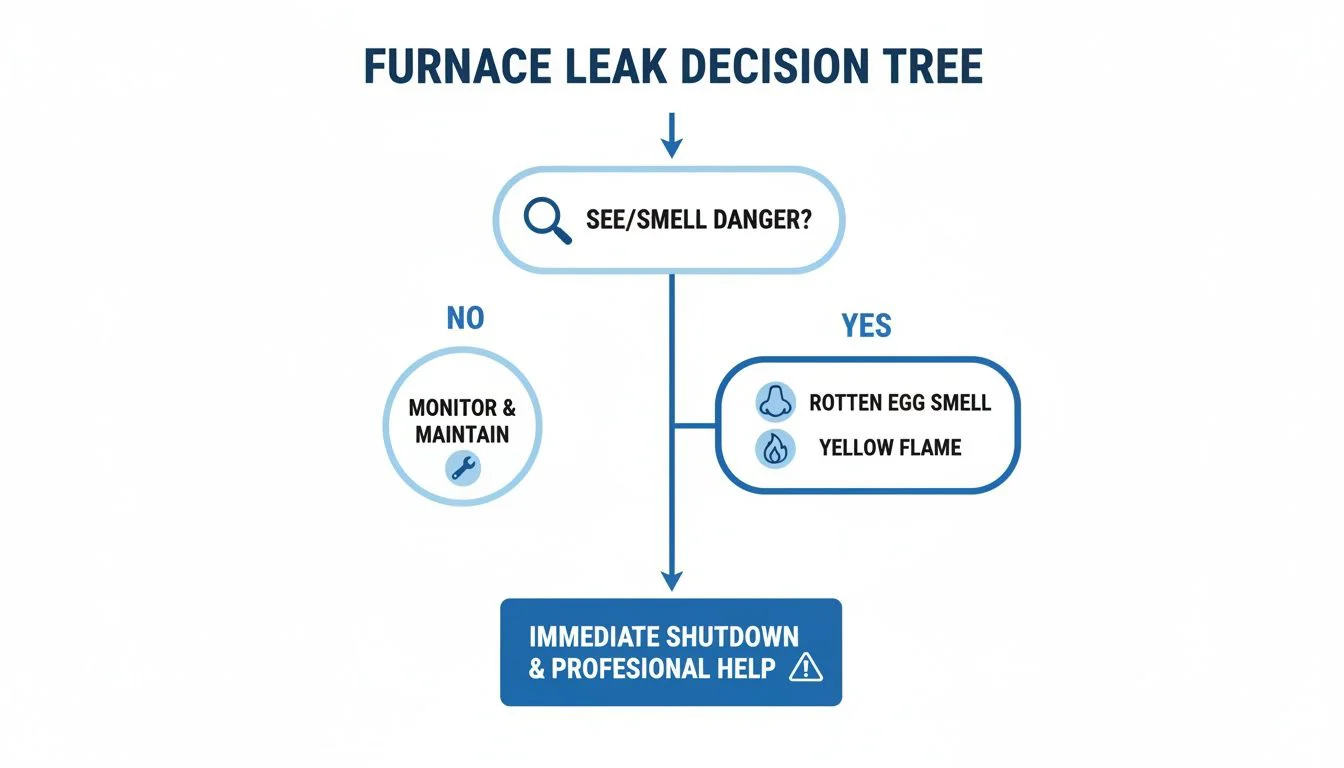
As you can see, any sign of a gas leak or improper combustion (like a yellow flame instead of a blue one) is an immediate stop sign. It bypasses all other diagnostics and goes straight to "Call a Professional."
A licensed, insured HVAC technician doesn't just bring parts; they bring specialized diagnostic tools and years of hands-on experience. They can pinpoint the root cause of a problem and fix it safely and correctly the first time. If you decide to call someone, finding a reputable local company is key. Many of the best techs I know get their business from a strong local reputation, often boosted by things like solid local SEO for HVAC companies.
Ultimately, investing in a professional isn't just about fixing your furnace—it's about ensuring your family's safety and your own peace of mind.
A Few Common Questions We Hear About Furnace Problems
Even after walking through the basics, it's normal to have a few more questions about what your furnace is doing—or not doing. A good diagnosis comes from understanding the specific symptoms. Here are the answers to some of the most common questions we get from homeowners right here in Central Minnesota.
Why Does My Furnace Keep Turning On and Off So Much?
That constant on-and-off routine has a name: short cycling. And it’s a big red flag that something is off.
Nine times out of ten, the culprit is a severely clogged air filter that’s choking off the airflow. When your furnace can't "breathe," it overheats fast, tripping a safety switch that shuts everything down. Once it cools off, it just tries to start up again, repeating the cycle. This puts a ton of unnecessary strain on parts like the blower motor and heat exchanger.
While a dirty filter is always the first thing to check, a bad thermostat or even a furnace that's oversized for your house can also cause it. Start with the filter—it's the easiest fix.
How Would I Even Know If My Heat Exchanger Is Cracked?
This is one of the most serious furnace failures out there. A cracked heat exchanger can leak deadly carbon monoxide gas right into your home. The tricky part is you can't actually see the crack without a technician taking the furnace apart. But you can spot the warning signs.
Keep an eye out for these red flags, because they require immediate action:
- The burner flame looks lazy, flickering, or yellow instead of crisp and blue.
- You see black soot streaks collecting on the furnace cabinet near the burners.
- Someone in the house has unexplained flu-like symptoms (headaches, dizziness, nausea) that seem to magically get better when they leave.
If you spot any of these, shut your furnace off at the breaker panel, open your windows to get fresh air moving, and call a pro right away. Don't ever take a chance with a suspected cracked heat exchanger.
Is Annual Furnace Maintenance Really That Important?
Yes, 100%. Skipping your annual furnace tune-up is a lot like never changing the oil in your car. You might get away with it for a season or two, but eventually, you're heading for a much bigger and more expensive breakdown. On top of that, most furnace manufacturers actually require you to show proof of annual maintenance to keep your warranty valid.
A professional tune-up is more than just a quick look-over. The technician will clean critical components like the flame sensor and burners, test all the safety controls, check gas pressure, and look for any small signs of wear that could turn into a full-blown failure on the coldest night of the year.
This is preventative care, plain and simple. It helps your system run safely and efficiently, which can make a real difference in your monthly heating bills.
What's Up With the Blinking Lights on My Furnace?
Those blinking LED lights on your furnace’s control board are actually talking to you. It's a built-in diagnostic system. The lights flash in a specific pattern to signal an error code, which helps a technician figure out where the problem is coming from. Think of it as your furnace’s way of saying where it hurts.
You can usually find a chart right on the inside of the furnace access panel that tells you what the codes mean. For example, three flashes might point to a pressure switch problem, while four flashes could mean the high-limit switch has tripped. The code gives you a starting point, but fixing the actual problem often involves messing with complex parts and is best left to a qualified technician.
Dealing with furnace problems can be a real headache, but you don't have to figure it out alone. If you've tried the basics and the heat is still off, the licensed and insured technicians at Neighborhood Plumbing, HVAC, and Electrical are here to help 24/7. We give you upfront pricing and expert service to get your home warm again, safely and quickly. Schedule your furnace repair with us today!