If your furnace clicks on, runs for about 30 seconds, and then shuts right back off, you’re experiencing a classic safety shutdown. It’s a frustrating cycle, but it’s actually your furnace’s way of telling you something is wrong before it becomes a bigger, more dangerous problem.
The two most common culprits? A clogged air filter that's starving the system for air, or a dirty flame sensor that can't confirm the burners are actually lit. This quick shutdown, which pros call "short cycling," is an issue most homeowners can start troubleshooting themselves.
What's Going On When Your Furnace Shuts Off So Quickly?
That click-on, click-off sequence isn't just an annoyance—it's your furnace doing its job. Think of it as a built-in protection system. During its startup sequence, the furnace runs a series of critical safety checks, and if any one of them fails, it immediately cuts power to prevent damage or a hazardous situation.
This rapid shutdown is what we in the HVAC world call short cycling. It happens when a safety device detects a fault and kills the power to the burners. The system might try to restart a few more times, but eventually, it will lock itself out, leaving you stuck in the cold. Figuring out what’s triggering that safety response is the first step to getting your heat back on.
The Most Common Culprits
For the vast majority of homeowners dealing with this, the problem usually boils down to just a couple of simple issues. You don't need to be an HVAC expert to understand what's happening inside your unit.
Here are the most frequent causes we see in the field:
- Restricted Airflow: A severely clogged air filter is the number one reason for this kind of short cycling. It’s like trying to breathe with a hand over your mouth—the furnace just can't get enough air.
- Dirty Flame Sensor: This is a thin, pencil-like metal rod with a very important job: to confirm there’s a flame. If it’s covered in soot or residue, it can't "see" the flame, so it tells the furnace to shut off the gas as a precaution.
- Faulty Thermostat Signals: Sometimes the furnace isn't the problem at all. A malfunctioning thermostat, often due to low batteries or a bad connection, can send confusing on-and-off signals.
When a furnace short cycles because of a dirty filter, what’s really happening is the heat has nowhere to go. The heat exchanger gets dangerously hot, and a safety device called the high-limit switch trips to shut the burners down. This is what creates that frustrating on-off loop. You can learn more about how airflow impacts your furnace's health from the experts at VEH Brothers.
Pro Tip: A furnace that shuts off almost immediately is rarely a sign of total failure. More often, it’s a simple safety check failing. Many of these issues are tied to basic maintenance you can handle yourself.
Before diving into troubleshooting, it's helpful to see the most common causes at a glance. This table summarizes the key issues, what they mean, and your first move.
Common Reasons Your Furnace Short Cycles
| Potential Cause | What's Happening | First Step to Take |
|---|---|---|
| Clogged Air Filter | The furnace is overheating because it can't get enough airflow. The high-limit switch trips. | Check and replace your furnace filter. |
| Dirty Flame Sensor | The sensor can't detect the flame, so it shuts off the gas supply for safety. | Inspect the flame sensor rod for soot and clean it carefully. |
| Blocked Flue/Vent | Exhaust gases can't escape, triggering a pressure switch to shut the system down. | Check for obstructions like snow, leaves, or animal nests around the exterior vent pipes. |
| Condensate Line Clog | For high-efficiency furnaces, a blocked drain line can trip a safety switch. | Inspect the clear plastic tubing for water backup and clear any clogs. |
This quick guide should give you a solid starting point. Remember to always turn off the power to your furnace at the breaker before opening any panels or touching components.
First-Line Fixes You Can Safely Perform
Okay, before you grab the phone and schedule a service call, take a breath. When a furnace shuts off after only 30 seconds, the problem is often something surprisingly simple—a maintenance issue you can probably handle yourself.
Walking through these common culprits first can save you a service fee and the headache of a cold house. Let's start with the number one offender we see in the field.
Check and Replace Your Furnace Filter
I can’t tell you how many service calls come down to this one thing: a clogged air filter. It's the single most common reason a furnace will overheat and shut itself down.
Think of it like this: your furnace is trying to run a marathon while breathing through a coffee straw. It just can't get the air it needs. When that airflow gets choked off, heat gets trapped inside the unit until a safety sensor, the high-limit switch, trips and kills the power. It's doing its job, protecting the furnace from damage.
First, you need to find the filter. It's almost always in a slide-in slot right on the furnace cabinet or in the main return air duct connected to it.
- Kill the Power First: This is non-negotiable. Head to your breaker box and shut off the power to your furnace before you open any panels. Safety first, always.
- Locate and Remove It: Slide the old filter out. You'll see the size printed on the cardboard frame (like 16x25x1). Snap a picture of it with your phone so you don't forget.
- Do the Light Test: Hold the filter up to a light. If you can't see the light coming through, it's toast. It’s long past time for a replacement.
Grab a new filter of the exact same size and slide it in. Pay close attention to the arrows on the frame—they need to point toward the furnace, following the direction of the airflow. Putting it in backward is just as bad as using a dirty one.
This simple flowchart shows why checking the filter is always the first move before you even think about calling for backup.
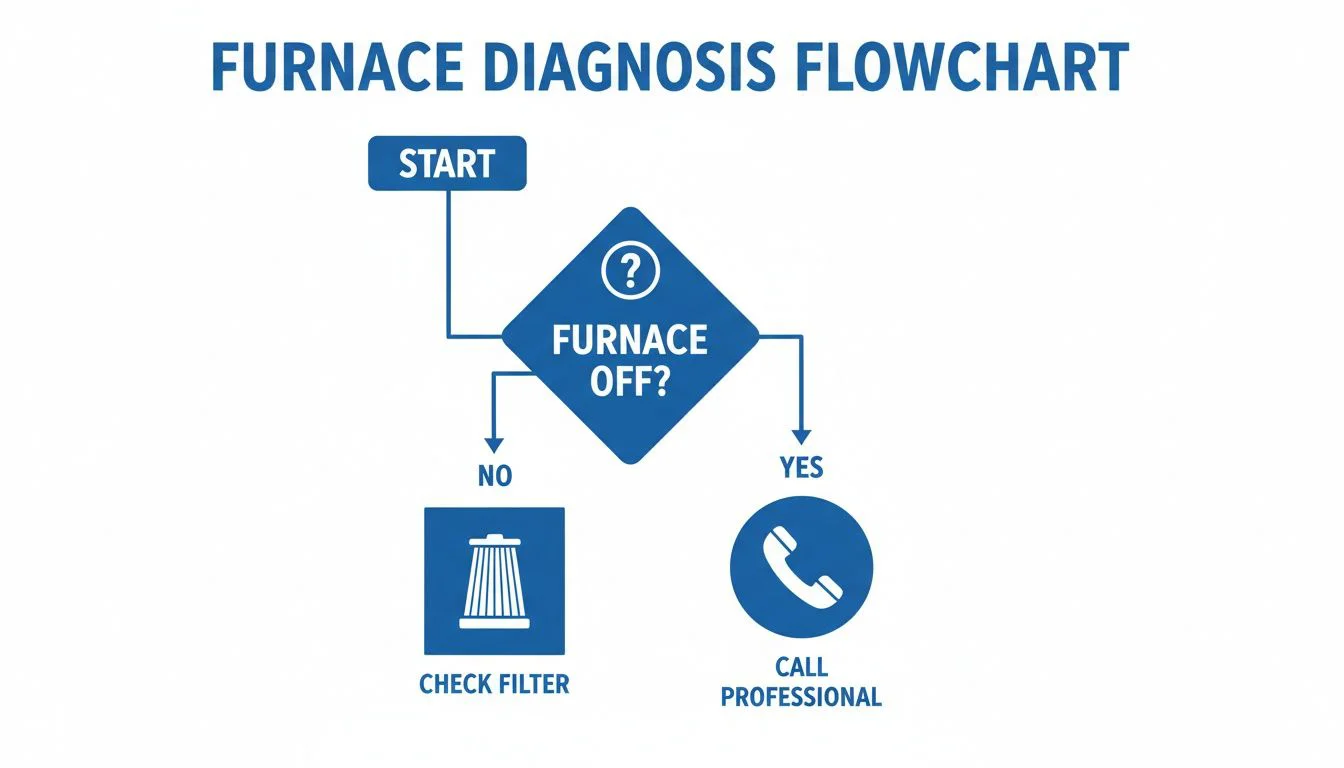
As you can see, a lot of roads lead back to that filter. It’s a cheap fix that solves a ton of problems.
Investigate Your Thermostat
If a fresh filter didn’t do the trick, your next stop is the thermostat. It's the brain of the whole operation, and if it’s sending wonky signals, your furnace will act up.
I've seen thermostats cause all sorts of "ghost" problems. Dying batteries can make them send erratic start-and-stop commands, or even just being in the wrong spot in a room can trick it into thinking the job is done.
Start with the easiest stuff first:
- Check the Batteries: A lot of digital thermostats run on batteries. If they’re getting low, the thermostat can get unreliable. Pop in a fresh set and see if that helps.
- Confirm Your Settings: This one sounds obvious, but you’d be surprised. Make sure the thermostat is set to HEAT, not Cool or Off. And check that the fan is set to AUTO. If it's on ON, the blower will run all the time, but the heat might not cycle correctly.
- Think About Location: Is your thermostat sitting in a patch of direct sunlight? Is it right above a hot TV or next to a lamp? Any external heat source can fool the thermostat into thinking the room is already warm, causing it to shut the furnace down way too early.
If you recently installed a new smart thermostat and then the problem started, there might be a wiring issue. Many newer models need a dedicated common wire (or "C-wire") for constant power. Without it, they can try to "steal" power by cycling the furnace on and off, leading to that frustrating 30-second shutdown.
How to Safely Clean a Dirty Flame Sensor
Alright, so you’ve already checked the easy stuff. The furnace filter is clean, and the thermostat seems to be working just fine. Now what? The next stop on our troubleshooting tour is the most likely culprit for a furnace that shuts off after about 30 seconds: a dirty flame sensor.
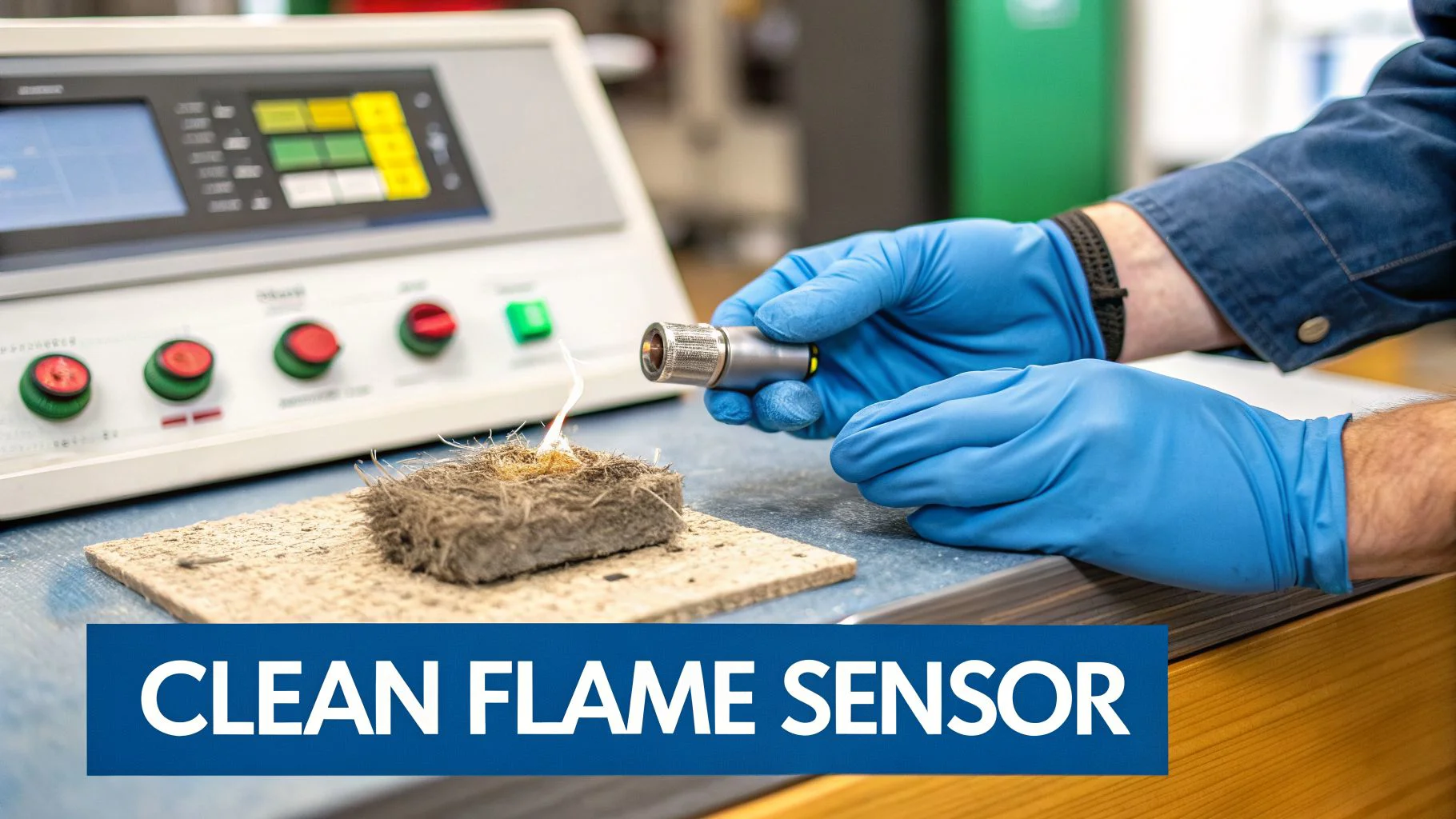
This little part has a huge job. It's a critical safety device that simply tells your furnace, "Yep, we have fire!" after the gas valve opens. Over a heating season, though, that sensor gets coated in a nearly invisible film of carbon and soot. When that happens, it can no longer "see" the flame, and the furnace's control board shuts off the gas to prevent a dangerous fuel leak. That's what causes the constant on-and-off cycling.
The good news? Cleaning it is a straightforward task for a confident DIY-er and can save you the cost of a service call.
Safety and Prep First
Before you even think about touching your furnace, you have to cut the power and gas. This is a non-negotiable safety step.
- Shut Off the Electrical Power: Head to your home's main electrical panel and find the breaker labeled "Furnace" or "HVAC." Flip it to the OFF position.
- Turn Off the Gas Supply: Look for the gas valve on the pipe leading into your furnace—it usually has a small lever handle. Turn the handle a quarter-turn until it's perpendicular to the pipe. That means it's off.
With both power and gas shut off, you can remove the furnace's main access panel. It's typically held on by a couple of screws, sometimes thumbscrews you can turn by hand.
A flame sensor is an incredibly simple part, but it's also delicate. It’s essentially a metal rod that sits in the path of the burner flame, but aggressive cleaning can damage its surface or crack the ceramic insulator. Gentle is the key word here.
Locating and Removing the Sensor
Once the panel is off, peer inside near the burners where the flames usually appear. The flame sensor is a thin, metallic rod, often bent into an "L" shape. It will have a single wire connected to its base and is held in place by just one screw, usually a 1/4-inch hex-head.
- Find It: The sensor is always positioned so it gets completely engulfed by the flame from the last burner in the row. Don't mix it up with the ignitor, which is thicker, looks more fragile, and sits at the start of the burner assembly. If you're having trouble, our guide can help you learn more about where the flame sensor is on a furnace.
- Remove It: Use a nut driver or a small socket wrench to carefully remove that single screw holding the sensor's bracket.
- Disconnect the Wire: Gently pull the wire connector straight off the sensor's base. Now you should be able to slide the whole flame sensor assembly out of the furnace.
Cleaning the Sensor Correctly
With the sensor in your hand, you can finally clean the metal rod. The goal is to gently buff off that carbon buildup without scratching or damaging the metal.
Use a light-grade piece of steel wool or, believe it or not, a clean, crisp dollar bill to lightly polish the rod. The slightly rough texture of the bill works wonders. Just rub it until the metal is shiny and smooth again. Do not use sandpaper, an abrasive sponge, or a wire brush. These are too harsh and will create tiny grooves on the rod that actually make carbon build up even faster next time.
Once it's clean, carefully slide the sensor back into its spot, secure it with the screw, and reconnect the wire. Put the furnace panel back on, then restore the gas and electrical power. Finally, turn up your thermostat to call for heat and watch what happens. If that dirty sensor was the problem, your furnace should now fire up and stay running like it's supposed to.
When to Put Down the Tools and Call an HVAC Pro
There’s a lot to be said for a homeowner who’s willing to get their hands dirty. But knowing your limits is probably the most important skill you can have. If you’ve already changed the filter and carefully cleaned the flame sensor, and that furnace is still shutting off after 30 seconds, it’s time to stop.
Honestly, this is the point where continuing to troubleshoot on your own can lead to much more expensive damage. Worse, it can create a serious safety hazard for your family. This isn't about giving up; it’s about making a smart, safe call. The symptoms you’re seeing are now pointing to complex problems that are well beyond a typical DIY fix and require specialized tools and a licensed technician.
Signs That Demand a Professional
When the simple fixes don’t work, your furnace is basically waving a red flag about a deeper issue. Trying to guess your way through these problems can turn a straightforward repair into a major system replacement. It's time to call a pro if you suspect any of the following.
Failing High-Limit Switch: This is your furnace’s main safety sensor, designed to shut the unit down to prevent overheating. But what if the switch itself is faulty? It can trip even when temperatures are normal, causing that 30-second shutdown. A technician needs to test its continuity and resistance with a multimeter to know for sure if it’s the culprit.
Control Board Malfunction: Think of the control board as the furnace's brain. If it's on the fritz, it might not send the right voltage to key parts like the gas valve, or it might misinterpret the signals from the flame sensor. We’ve seen cases where homeowners have even installed a brand-new board themselves, only for the problem to continue because the new board was defective or incompatible.
Gas Pressure Imbalances: The gas valve needs to receive a very precise amount of natural gas or propane to run safely. If the pressure is too low, it won’t light properly. If it’s too high, it’s incredibly dangerous. Adjusting gas pressure requires calibrated manometers and is something you should never, ever attempt unless you are a licensed professional.
These are issues that are impossible to diagnose accurately without the right tools and a deep understanding of your furnace’s operating sequence. Guesswork here can be disastrous.
The most critical reason to call a professional is the risk of a cracked heat exchanger. This component keeps the combustion gases separate from the breathable air blown into your home. A crack can leak deadly, odorless carbon monoxide gas directly into your living space.
A furnace that shuts off after 30 seconds because a limit switch is tripping can be a direct symptom of a cracked heat exchanger causing poor combustion and overheating. An HVAC tech will use a combustion analyzer and a special camera to inspect the heat exchanger thoroughly—something no homeowner can do.
Your family’s safety is not worth the risk. If basic maintenance didn't solve the problem, your very next step should be calling a trusted local company like Neighborhood Plumbing, HVAC, and Electrical.
Understanding Repair Costs and The Value of Prevention
Let's be honest, nobody enjoys an unexpected furnace repair bill, especially when you're just trying to stay warm. Knowing what a professional repair might actually cost can take some of the sticker shock out of the equation and help you make a good call for your home.
When your furnace is shutting down after just 30 seconds, the final bill can swing wildly depending on what’s actually broken. A simple fix might be surprisingly affordable, but a more serious problem will obviously require a bigger investment.
A Look at Potential Repair Costs
So, you’ve tried all the easy DIY checks and the furnace is still acting up. It's time to call in a pro. Here's a realistic look at what you can expect to pay for the most common fixes for this exact issue.
- Flame Sensor Replacement: If cleaning the sensor didn’t do the trick or it’s just at the end of its life, having a technician replace it is a quick job. This usually runs between $150 and $300, which covers both the part and the labor.
- Limit Switch Replacement: A faulty high-limit switch that’s tripping when it shouldn't is another frequent culprit. Swapping this part out typically costs somewhere in the $200 to $450 range.
- Control Board Replacement: This is the furnace’s brain, so it's a much bigger deal. If the board has failed, a replacement can run from $600 to over $1,200, depending heavily on your furnace model.
Don't forget the thermostat! Sometimes a faulty thermostat is the one sending bad signals and causing the furnace to short cycle. It could be due to old wiring, dead batteries, or even just being installed in a bad spot (like right next to a lamp). In fact, simply moving a thermostat can fix short-cycling issues in up to 25% of cases, but if the unit itself is the problem, a professional replacement usually costs between $200-$500. As you can see, that's a pretty modest investment compared to other emergency repairs. You can read more about these thermostat findings from the HVAC experts at Petro.com.
The Best Repair is The One You Avoid
While it's good to be prepared for repair costs, it's way better to avoid them in the first place. The single best thing you can do to prevent your furnace from quitting on you is to get it professionally maintained. An annual furnace tune-up isn't an upsell; it's the most critical preventative step you can take.
Think of a furnace tune-up like an annual physical for your HVAC system. A technician doesn't just look for problems—they clean, test, and calibrate all the key components to make sure they're running safely and efficiently. This is how you catch failing parts before they leave you in the cold.
During a tune-up, a technician will clean the flame sensor, inspect electrical connections, test all the safety switches, and measure component performance. This proactive service is what stops the exact problems that cause a furnace to short cycle.
This small investment pays you back in a few big ways:
- Enhanced Reliability: It dramatically cuts down the odds of a breakdown in the middle of winter.
- Improved Safety: Technicians can spot tiny cracks in a heat exchanger that could lead to a carbon monoxide risk.
- Better Efficiency: A clean, fine-tuned furnace uses less fuel to heat your home, which saves you money.
Fixing issues like short cycling isn't just about keeping your system running; it's also about making your home more efficient. If you want to dive deeper into strategies that can help you reduce heating costs, this is a fantastic resource. A well-maintained furnace is the foundation of an energy-smart home, and you can learn more about the value of a furnace tune-up in our guide.
Common Questions About Furnace Short Cycling
It’s completely normal to have a million questions when your furnace starts acting up, especially with a problem as specific as this one. A heater that shuts off after just 30 seconds can send anyone into a panic.
We get these calls all the time, so let’s walk through the most common questions homeowners ask when they’re left in the cold. Understanding what’s going on is the first step to getting it fixed.
Is My Furnace Broken for Good?
Probably not. When a furnace shuts down that fast, it’s almost always a safety feature kicking in and doing its job. Think of it as your furnace slamming on the brakes to avoid a bigger accident.
It’s not a sign that the whole unit is toast. More often, it’s pointing to something simple, like a dirty flame sensor that can't confirm a fire has started, or a clogged filter that's choking off airflow. It’s a warning light, not a death sentence for your heater.
Is It Dangerous for the Furnace to Keep Trying?
Yes, letting your furnace go through this on-and-off cycle over and over is a bad idea. While the safety switches are there to prevent an immediate catastrophe, all that jarring from constant starting and stopping puts a ton of strain on key parts.
- Blower Motor: Abrupt, frequent starts are tough on the motor and can shorten its lifespan.
- Control Board: The electrical stress can easily fry the sensitive relays on the main circuit board.
- Ignitor: This is a fragile part to begin with. Excessive cycling can cause it to crack or burn out much faster.
For a closer look at the risks, you can learn more about whether furnace short cycling is dangerous in our detailed guide. The smartest move is to just turn the system off at the thermostat until you can get the root cause fixed.
Key Takeaway: Short cycling is a symptom, not the actual problem. The furnace is shutting itself down to prevent a more serious issue, like overheating or leaking unburnt fuel. You have to fix the underlying cause to solve it for good.
Why Did This Problem Start So Suddenly?
I know it feels like it came out of nowhere, but the root cause has likely been building up for a while. A flame sensor doesn't get caked in carbon overnight—that’s a slow, gradual process. The same goes for an air filter, which clogs up over weeks or months.
You just happened to hit the tipping point where the furnace’s safety sensors couldn't ignore the problem anymore. Your system was probably struggling quietly long before it started this very noticeable on-off routine.
When you've checked the simple stuff and the furnace still refuses to cooperate, it’s time to call in the pros. For reliable, 24/7 service in Central Minnesota, you can count on Neighborhood Plumbing, HVAC, and Electrical to diagnose the problem correctly and get your heat running again. Schedule your repair online today!