That first crisp Minnesota night is always a reminder: it’s time to wake up the furnace. But before you just flip the switch and hope for the best, a few simple checks can save you from a major headache—and a chilly house.
Think of it as a pre-flight checklist for your heating system. Taking a few minutes now can prevent common startup problems and keep your home both warm and safe all winter.
Your Pre-Startup Furnace Checklist
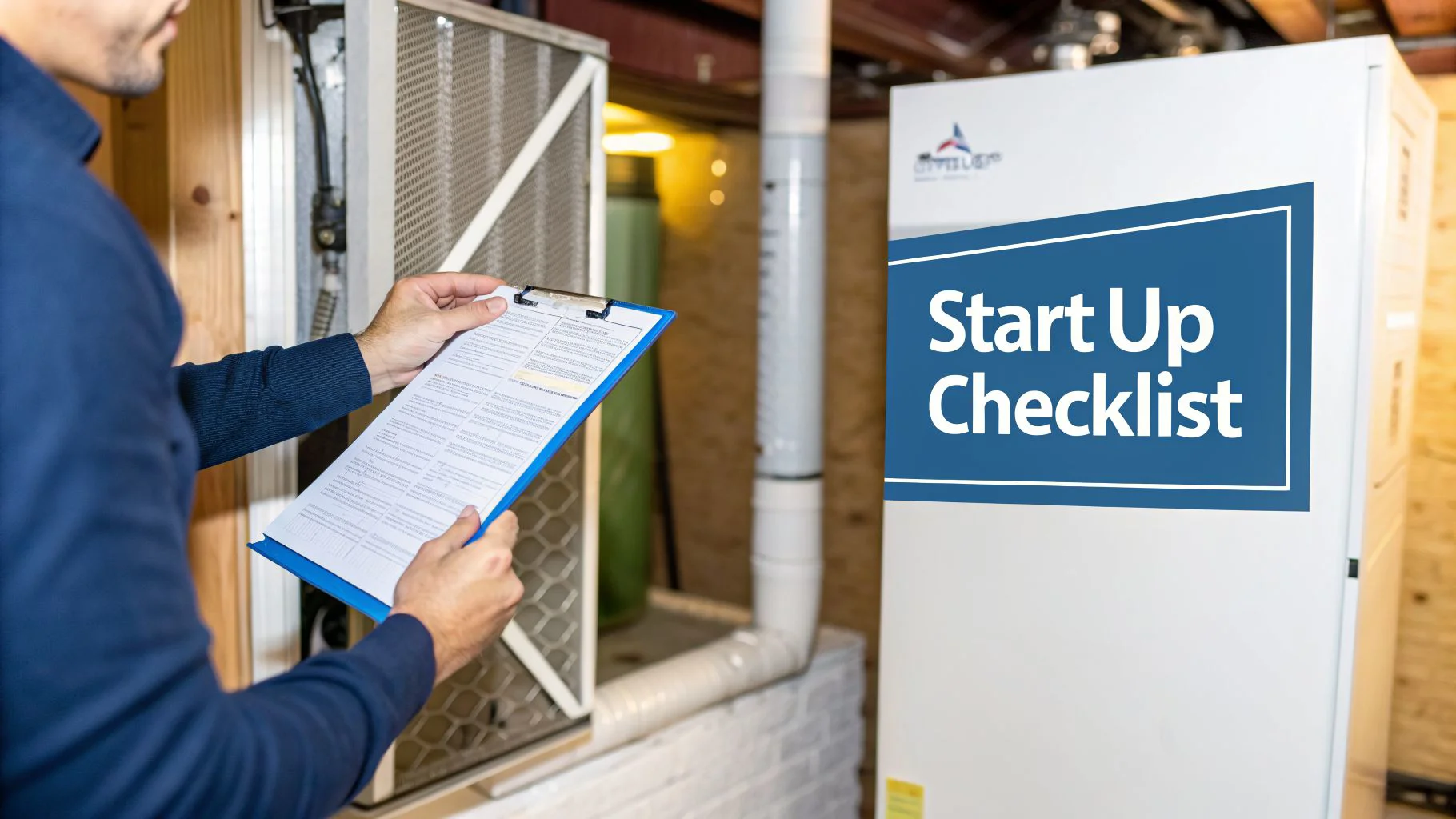
Before you even think about touching the thermostat, a quick walk-through can mean the difference between a cozy evening and a frustrating call to a technician. We see it every year. A few basic checks are all it takes to catch the little things that cause big problems.
Confirm Power and Filters First
More often than not, a furnace that won't start is down to one of two simple issues. No matter what kind of furnace you have, always start here.
Check the Breaker and Service Switch: Head to your home's main electrical panel and find the breaker labeled "Furnace" or "HVAC." Make sure it’s flipped firmly to the “ON” position. Next, look for a dedicated service switch right on or next to your furnace—it usually looks like a regular light switch on a metal box. That needs to be on, too.
Replace the Air Filter: A dirty, clogged filter is hands-down the #1 reason we get no-heat calls in the fall. A fresh filter guarantees good airflow, which is critical for your furnace to run efficiently and safely. This one small step prevents your system from overheating and shutting itself down.
These two actions alone solve a surprising number of startup failures. In fact, improper startup contributes to 30% of seasonal HVAC failures, and we see service call demand spike by 75% in early November. Homeowners who perform these basic checks can cut potential repair costs by an average of 50%. You can explore more data on residential furnace trends to see how preventive care pays off.
Quick Startup Actions Gas vs Electric Furnaces
To make it even simpler, here's a quick table summarizing those universal first steps and the immediate next action depending on your furnace type.
| Checklist Item | Gas Furnace Action | Electric Furnace Action |
|---|---|---|
| Check Breaker Panel | Ensure the furnace breaker is in the "ON" position. | Ensure the furnace breaker is in the "ON" position. |
| Check Service Switch | Flip the switch on or near the unit to "ON". | Flip the switch on or near the unit to "ON". |
| Replace Air Filter | Install a clean, new filter for proper airflow. | Install a clean, new filter for proper airflow. |
| Verify Fuel/Energy | Confirm the gas supply line valve is open. | No extra step needed; power is already confirmed. |
This table covers the essentials that get you ready for the next phase of the startup process, which differs slightly between gas and electric models.
Pro Tip: Before you go any further, it really helps to know what you're working with. The steps for starting a gas furnace are different from an electric one. If you're not sure, check out our guide on how to tell if your furnace is gas or electric for a quick rundown.
Critical Safety Checks Before Ignition
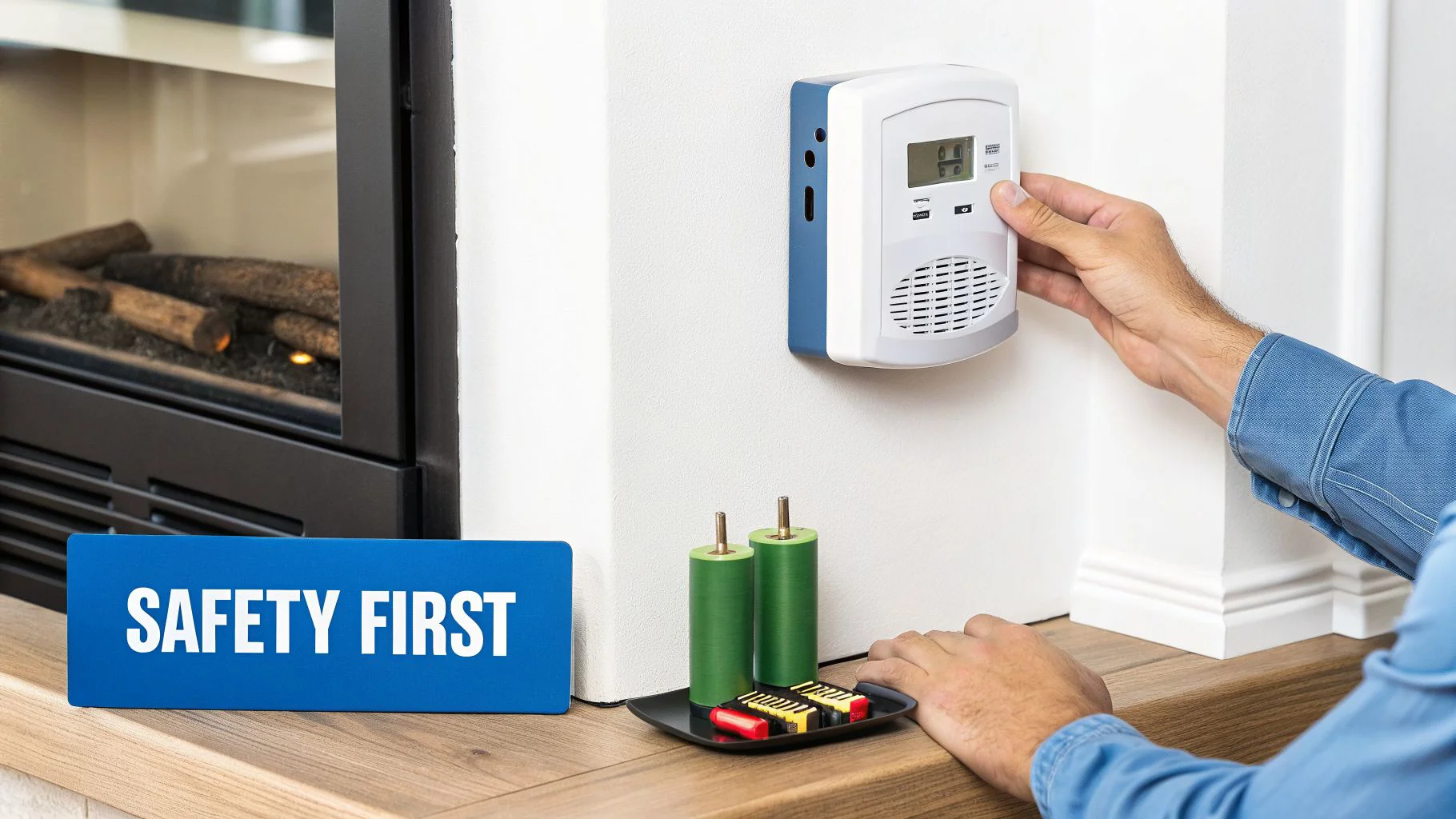
Before you flip that switch and welcome the warmth back into your home for the season, there are a few safety checks that are absolutely non-negotiable. It’s tempting to rush this part, but taking just a few minutes now ensures your home and family are protected when you finally turn up the heat.
Let's start with the most important one, especially if you have a gas furnace: carbon monoxide (CO) safety. CO is a silent, odorless gas, which means your detectors are your first and only line of defense.
- Test every single CO detector. Go around and press the "test" button on each unit. You need to hear that loud, piercing alarm. If it's silent or weak, you’ve got a problem.
- Put in fresh batteries. Don't just wait for that annoying low-battery chirp to start. Make it a habit to replace the batteries in every detector at the start of the heating season. It’s cheap peace of mind.
This isn't just busywork. Some studies show that issues related to turning on furnaces can contribute to 22% of carbon monoxide incidents, and an eye-opening 35% of these cases involve detectors that failed simply because of dead batteries.
Clear the Area and Inspect Vents
Next up, your furnace needs some personal space to work safely. The area around the unit must be totally clear of anything flammable. We're talking about stray laundry baskets, old paint cans, cleaning supplies, or boxes you stored there over the summer.
We often see items stacked right against the furnace during service calls. You have to maintain a three-foot clear zone around the unit. It's not just a fire hazard; it’s also essential for proper airflow.
Finally, just do a quick walk-around. Take a look inside the furnace cabinet for any signs of pests that might have moved in, like droppings or chewed wires. Then, stroll through your house and make sure all your heating vents and registers are open and aren't blocked by furniture, rugs, or drapes. A single blocked vent can create pressure problems, leading to component damage and even a faulty flame sensor. If you want to learn more, check out our guide on how to find the flame sensor on a furnace.
Starting Up a Gas Furnace
Gas furnaces are the workhorses of home heating, found in over 53.2% of homes. Getting one started for the season is all about handling the gas supply safely and knowing what kind of furnace you have.
Your first step is to figure out if your furnace has a classic standing pilot light or a more modern electronic ignition. Older units have a tiny flame that burns constantly—the pilot light. If you don’t see a flame, you almost certainly have an electronic system.
For Furnaces with a Pilot Light
If you’ve got an older furnace, your main job is to relight that pilot. It's a pretty simple process, but you need to be careful.
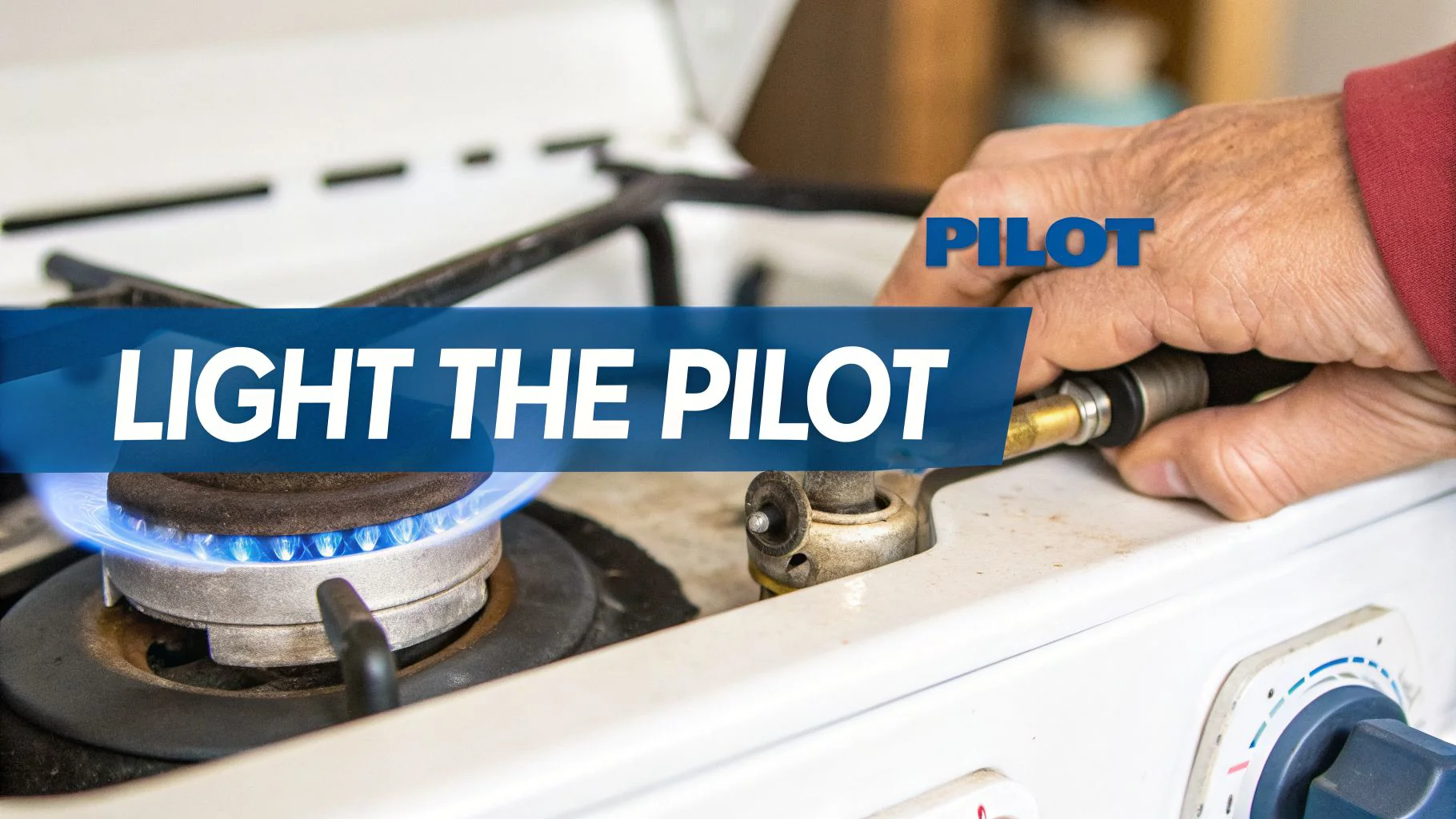
Start by finding the gas control knob, usually on the furnace's gas valve. You'll see settings like "ON," "OFF," and "PILOT." Turn the knob to "OFF" and then step away for at least five minutes. This gives any lingering gas a chance to clear out completely. Don't skip this wait time.
After five minutes, switch the knob to the "PILOT" setting. You’ll need to press and hold this knob down, which starts the gas flowing to the pilot burner. While holding it down, use a long-reach lighter to carefully ignite the flame.
Once the pilot is lit, keep holding that knob down for about 30 to 60 seconds. You're heating up a safety device called a thermocouple. If the pilot ever goes out, a cool thermocouple automatically shuts off the gas. Once it’s hot, you can let go of the knob, and the pilot should stay lit. From there, just turn the knob to the "ON" position.
Safety First If you smell gas at any point, stop what you're doing. Leave the house immediately, and don't touch any lights or electronics. Once you're safely outside, call your gas company or a certified HVAC pro.
For Furnaces with an Electronic Igniter
Modern furnaces are much simpler. There’s no pilot light to worry about because the furnace creates its own spark or heats an element whenever the thermostat calls for heat.
For these systems, the most important thing is to make sure the main gas supply is actually turned on. Look for the gas line running into your furnace and find its shut-off valve. The valve handle should be parallel with the pipe, which means it's open. If it's perpendicular to the pipe, it's closed, and your furnace isn't getting any fuel.
You'd be surprised how often this is the problem. Service data shows that around 45% of "no heat" calls come from simple things like closed valves or dirty filters. In fact, a forgotten valve is behind nearly 18% of emergency calls in October. You can find more furnace market facts and how they impact service calls.
Once you've confirmed the gas is on, just switch your thermostat to "HEAT" and turn up the temperature. You should hear a few clicks, maybe a small whirring sound, and then a soft "whoosh" as the burners ignite. That’s the sound of success.
Turning On an Electric Furnace
If you’ve got an electric furnace, you’re in luck when it comes to the fall startup. We see them a lot in newer homes around Forest Lake and Chisago City, and for good reason—turning them on is usually much simpler than a gas unit.
But simpler doesn’t mean you can skip the safety checks. With an electric furnace, it’s all about making sure the power is flowing correctly and safely. Your first stop is the breaker panel.
Your furnace is a power-hungry appliance, so it gets its own dedicated double-pole breaker. This will look like two breakers fused together with a single switch. Find the one labeled "Furnace" or "HVAC" and give it a look.
Make sure it’s pushed firmly to the "ON" position. If you find it tripped in the middle or switched off, flip it all the way to "OFF" first, then switch it back "ON" with a solid click.
Check the Power Switch and Thermostat
With the breaker on, your next task is to find the furnace's local power switch. This is almost always a regular light switch inside a gray metal box, mounted right on or next to the furnace itself.
This switch is often flipped off during summer maintenance and completely forgotten about. It needs to be in the "ON" position for the furnace to get any power, so don't overlook it.
Once that’s handled, you can head over to your thermostat.
- If it’s not hardwired, pop in some fresh batteries.
- Switch the system mode from "COOL" or "OFF" to "HEAT."
- Set the fan to "AUTO," not "ON." The "ON" setting just runs the fan constantly, which you don't want.
- Finally, crank the temperature a few degrees higher than the current room temperature to call for heat.
You should hear a click from the furnace within a minute or so, followed by the sound of the indoor blower fan starting up.
What If It Trips?
If that breaker trips again right after you turn it on, do not reset it again. A breaker that trips instantly is a huge red flag for a serious electrical problem like a short circuit. It's a clear sign to stop what you're doing and call a professional technician.
If the blower starts running but the air from your vents feels cool, just be patient for a moment. Unlike a gas furnace that produces heat almost instantly, the heating elements in an electric unit need a few minutes to warm up. If you’re still not feeling any warmth after five minutes, there might be a problem with the heating elements, and that’s a job for a pro.
Solving Common Furnace Startup Problems
So you’ve done everything right, flipped all the switches, and… crickets. Just cold air. Don't panic. This happens more often than you'd think, and it doesn't always mean a big, expensive repair is on the horizon.
Before you grab the phone to schedule a service call, let's walk through some of the most common hiccups we see when homeowners fire up their furnace for the first time all year. Many startup failures come down to a simple fix you can often handle yourself.
Maybe you hear the furnace click on, then click right back off. Or perhaps the blower fan is running, but the air blasting from your vents is stubbornly cold. These are classic clues, and they can point you right to the problem.
This flowchart lays out the basic power-up sequence for an electric furnace. It’s a great visual reminder of the path electricity takes to get your system running.
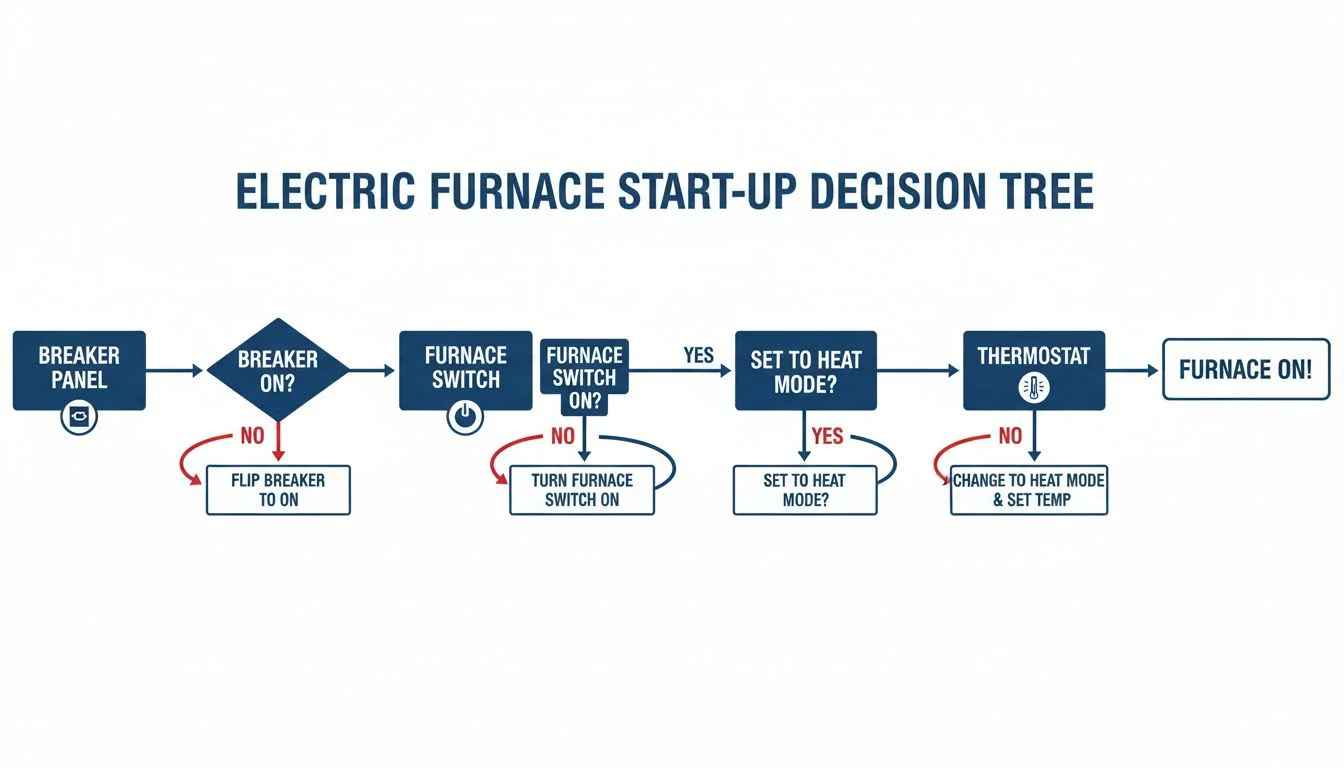
As you can see, it's a simple chain of command: breaker panel first, then the furnace's own power switch, and finally, the thermostat. If you miss even one of these, your furnace won't get the message to start making heat.
If you’ve double-checked all those and are still stuck, let’s dig a little deeper.
Furnace Clicks But Won't Ignite
This is probably the number one call we get in the fall. You hear a "click" as the furnace tries to start, a short pause, and then another "click" as the system gives up and shuts down. It might repeat this cycle a few times.
Nine times out of ten, this little routine points to a dirty flame sensor. This is a small metal rod that acts as a safety checker, telling the furnace, "Yep, we have fire!" Over a year, this sensor can get coated in soot and residue, which prevents it from detecting the flame. As a safety measure, the furnace cuts the gas supply.
You can often fix this yourself in about five minutes. Gently clean the flame sensor with a piece of fine-grit sandpaper or even a crisp dollar bill. A quick scrub is usually all it takes to save you a service call fee.
If cleaning the flame sensor doesn't work, the other likely suspect is a weak or faulty igniter. If the igniter can't get hot enough to light the gas, the whole startup sequence will fail.
The Blower Runs But Air Is Cold
Here’s another common head-scratcher: the blower fan kicks on like it's ready for business, but the air coming out of your vents is just room temperature. It never gets warm.
First, a little patience. If you have an electric furnace, give it at least five minutes. The heating elements don't produce instant heat; they need a few minutes to warm up and get glowing.
But if you’ve waited and the air is still cold, the problem is often a tripped high-limit switch. This is another safety device that shuts off the burners (on a gas furnace) or heating elements (on an electric one) if the unit starts to overheat. A dirty, clogged air filter is the most common reason for this, as it chokes off airflow and traps too much heat inside the furnace.
The blower will often keep running to try and cool the system back down, which is why you feel that unheated air.
Troubleshooting Common Furnace Startup Issues
When your furnace acts up, the symptoms can feel random. But each one is a clue pointing toward a specific problem. This table breaks down what those clues might mean and what you can do about them.
| Symptom | Potential Cause | What You Can Do |
|---|---|---|
| Nothing happens at all | No power to the furnace. | Check the breaker, the furnace power switch, and ensure the furnace cabinet door is securely closed. |
| Furnace clicks but won't light | Dirty flame sensor or faulty igniter. | Try gently cleaning the flame sensor. If that fails, the igniter may need to be replaced. |
| Blower runs, but air is cold | Clogged air filter causing a tripped limit switch. | Check and replace your furnace filter. Wait 30 minutes for the limit switch to reset. |
| Pilot light is out (older furnaces) | Drafts, dirty orifice, or thermocouple issue. | Follow the manufacturer's instructions to safely relight the pilot. If it won't stay lit, the thermocouple may be bad. |
| Thermostat is blank | Dead batteries or a wiring issue. | Replace the thermostat batteries. If the screen is still blank, check the C-wire connection. |
These simple checks can solve a surprising number of startup issues. However, if you've run through these steps and your home is still cold, it's a good sign that a deeper issue is at play. Don't hesitate to call a licensed HVAC technician for help.
When to Call a Professional
Knowing when to put the tools down and call a pro is just as important as any DIY step. While a lot of furnace startup hiccups are simple fixes, some are serious red flags. Messing with these can be dangerous, and your safety is always worth more than saving a few bucks on a service call.
If you smell gas, even just a little, stop everything. Get yourself and your family out of the house immediately. Don't flip any light switches, don't use your phone, and don't create any sparks. Once you're safely outside, call your gas utility company and then a certified HVAC technician. This is an emergency, plain and simple.
Warning Signs to Watch For
Beyond the obvious gas smell, a few other signs tell you it’s time to back away from the furnace and let an expert take over. Don't try to push through these issues:
- Loud Metallic Noises: We’re talking about loud banging, screeching, or grinding—the kind of sounds that make you jump. This usually points to a major mechanical problem, like a broken blower component or a motor that’s about to give out.
- Yellow Pilot Light: On a gas furnace, a healthy pilot light is a crisp, steady blue. If you see a weak, flickering, or yellow flame, that’s bad news. It means the gas isn’t burning completely, which can create deadly carbon monoxide.
- Persistent Breaker Trips: Does the furnace breaker trip every time you try to turn it on? Don't just keep resetting it. This is your home’s electrical system screaming that there’s a serious fault.
A furnace that keeps tripping the breaker or has a lazy, flickering pilot light isn't just an inconvenience; it's a real safety hazard. These issues can point to some serious problems, like a cracked heat exchanger or a dangerous electrical short that you do not want to handle yourself.
These symptoms are way beyond a simple DIY fix. To protect your home and your family, the right move is to contact a professional. This is also a good reminder of how yearly maintenance on your furnace can help you catch these problems long before they become an emergency.
Furnace Startup Questions Answered
Even when everything goes right, firing up the furnace for the first time of the season can leave you with a few questions. It’s totally normal. Here are a couple of the most common concerns we hear from homeowners across Minnesota after that first chilly night.
Why Does My Furnace Smell Funny?
When you first switch the heat on, you might notice a distinct burning dust smell. Don't panic—this is completely normal and almost always harmless. Over the summer, a fine layer of dust and other tiny particles settles on your furnace’s internal parts, like the burners and the heat exchanger.
That smell is just the furnace burning off all that accumulated gunk. It should go away on its own within an hour or two. If you want to speed things up, just crack a few windows. However, if you smell something metallic, electrical, or if the burning odor sticks around for more than a few hours, shut the system down immediately and call a professional.
Is It Normal for My Furnace to Run More at First?
Yes, absolutely. When you turn on your furnace for the first time, your house has likely gotten pretty cold. The system has to work overtime to bring not just the air, but also the walls, floors, and furniture up to your set temperature.
Don't be surprised if your furnace runs for a long, continuous cycle initially. It’s playing catch-up. Once your home is warm, it should begin cycling on and off normally to maintain that temperature.
If the furnace continues to run constantly for hours after the house feels warm, that could signal a problem. You might be looking at an issue with poor insulation, leaky ductwork, or even a furnace that’s too small for your home. A technician can help you figure out what's really going on.
If strange smells persist or your furnace just isn’t acting right, don't wait for a small issue to become a big problem. The licensed technicians at Neighborhood Plumbing, HVAC, and Electrical are ready to help. For 24/7 service and peace of mind this winter, schedule your furnace check-up online.