That sudden, bone-chilling silence on a frigid Central Minnesota night is a sound every homeowner dreads. Your furnace, the unsung hero of our long winters, has gone quiet.
Before panic sets in and you start picturing frozen pipes, take a deep breath. In many cases, the solution is surprisingly simple—something you can likely handle yourself in just a few minutes without a service call.
This first-response plan will walk you through the most common and easily fixable issues. We'll start with the basics that account for a huge number of our service calls, helping you rule out the obvious before assuming the worst.
Your Furnace Stopped Working. Now What?
The goal here isn't to perform complex repairs but to eliminate the simple oversights that can mimic a major failure. Think of it as detective work—gathering clues to understand what's really going on with your heating system.
Here's where to start:
- Check the Thermostat: Is it actually set to "HEAT"? Is the temperature set several degrees higher than the current room temp? Sometimes, a smart thermostat losing its Wi-Fi connection or just dead batteries in a digital model is all it takes to shut things down.
- Verify the Power: Your furnace has a couple of power sources. Start with your home's main circuit breaker panel. Find the breaker labeled "Furnace" or "HVAC" and see if it has tripped to the middle or "OFF" position. If it has, flip it firmly back to "ON."
- Find The Hidden Switch: Nearly every furnace has its own dedicated power switch. It usually looks like a standard light switch and is located on a nearby wall or even the ceiling. It’s incredibly easy to flip this off by accident. Make sure it's in the "ON" position.
When a heating system won't kick on, it's frustrating. For those with different setups, understanding common reasons why a boiler not firing up can offer some helpful parallels in the troubleshooting process.
Before you dive in, here’s a quick, prioritized checklist of the first things you should look at. Working through these simple steps often solves the problem without needing to pick up the phone.
Quick Furnace Troubleshooting Checklist
| Check | What to Look For | Action to Take |
|---|---|---|
| Thermostat | Is it set to "HEAT"? Are the batteries dead? | Set to "HEAT," raise temp 5° above room temp, and replace batteries if needed. |
| Circuit Breaker | Is the furnace breaker tripped? | Find the breaker labeled "Furnace" or "HVAC" and reset it. |
| Power Switch | Is the furnace power switch turned off? | Locate the switch near the furnace and flip it to the "ON" position. |
| Air Filter | Is the filter visibly clogged with dirt and dust? | Hold it to the light. If you can't see through it, replace it with a new one. |
| Vents & Registers | Are any supply or return air vents blocked? | Check all rooms and clear any furniture, rugs, or drapes blocking airflow. |
Following this simple order helps you systematically rule out the most frequent—and easiest-to-fix—problems.
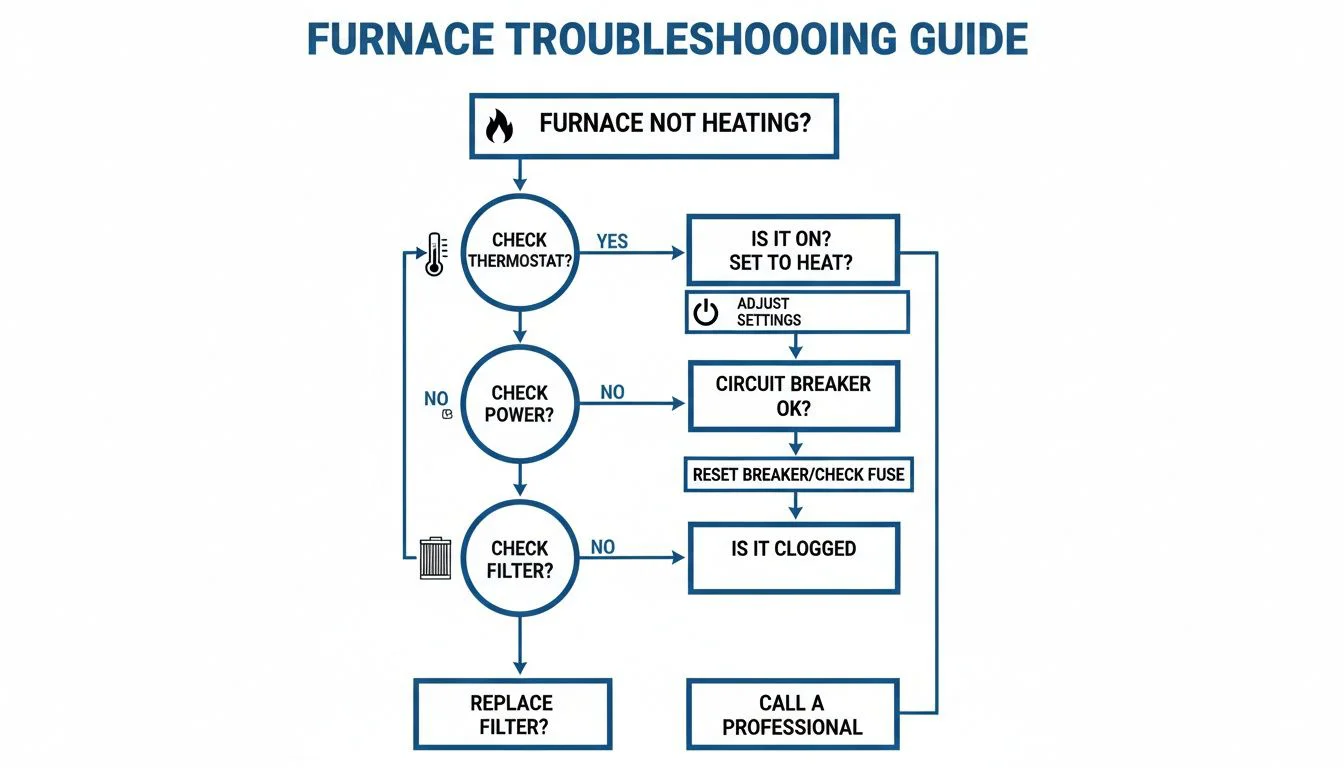
This simple flowchart helps visualize the order of operations when your heat goes out.
Don't Overlook The Air Filter
A severely clogged air filter is one of the top culprits for a furnace that shuts down unexpectedly. It's easy to forget, but it's critical.
When airflow is restricted, your furnace can overheat. This triggers a high-limit safety switch that shuts the entire unit off to prevent damage or a fire.
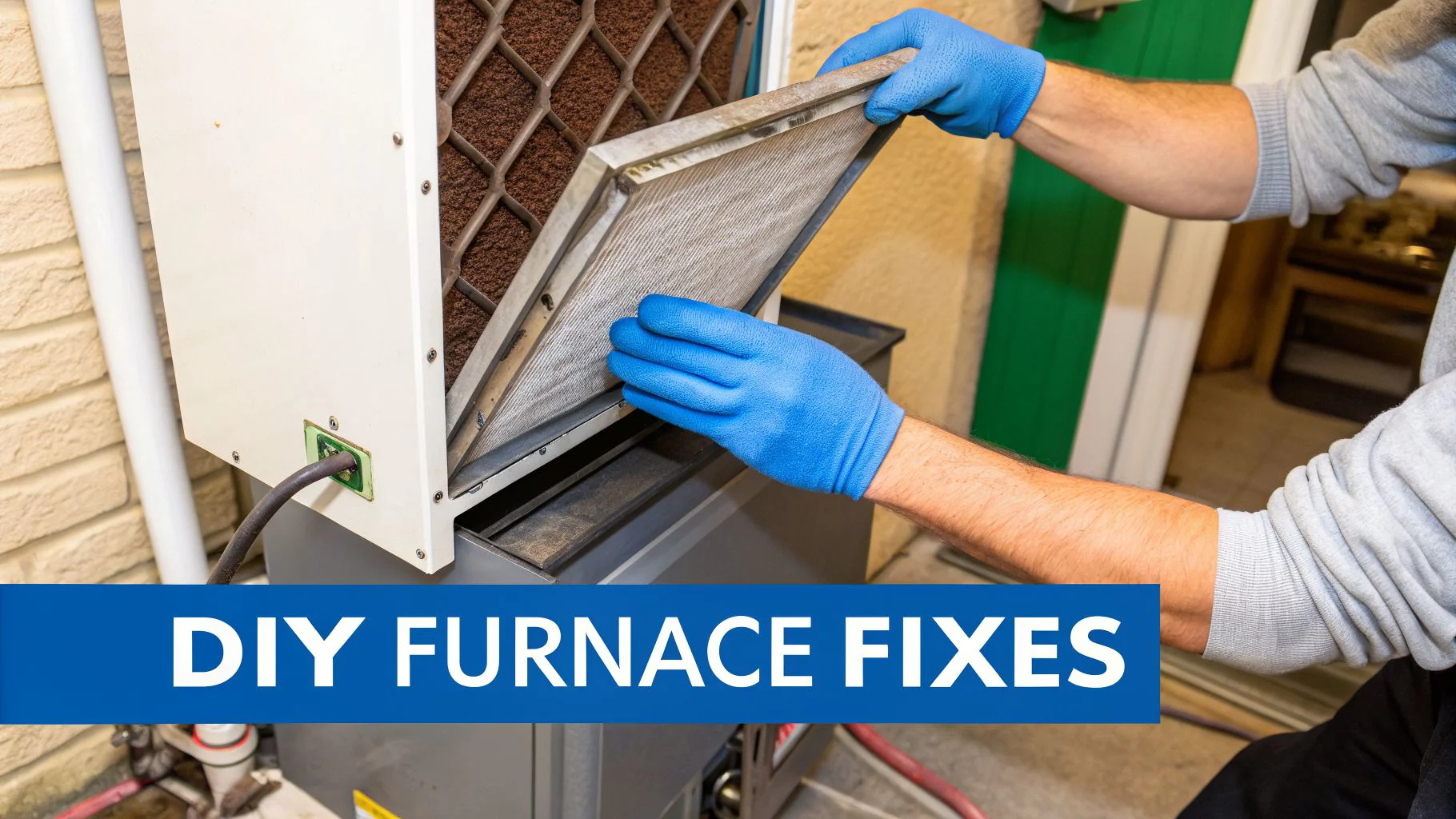
Pull your filter out and hold it up to a light. If you can't see light passing through, it’s way too dirty and needs to be replaced immediately. This single, inexpensive step restores proper airflow and might be all your furnace needs to start running again. Being prepared for these situations is key, and understanding https://4neighborhood.com/what-to-do-in-a-heating-emergency-in-minnesota/ can provide crucial context when the temperature drops.
Simple DIY Furnace Fixes You Can Safely Try
Alright, so the quick checks didn't do the trick. Don't throw in the towel just yet. There are a few more hands-on things you can safely try that often solve common furnace glitches without needing to call a technician. These next steps will let you dig a little deeper and tackle issues that are just beyond a simple oversight.
First up, let's try a full system reset. This is more than just flipping a switch—it reboots the furnace's internal computer, which can clear out minor electronic faults that caused it to shut down in the first place.
Properly Power Cycle Your Furnace
Think of it like restarting your computer when it freezes. A proper power cycle can resolve a surprising number of electronic hiccups happening on your furnace's control board.
Here’s the right way to do it:
- Turn Off the Thermostat: First, go to your thermostat and set it to the "OFF" position.
- Cut the Power at the Switch: Find the dedicated power switch for the furnace—it usually looks like a regular light switch on or near the unit—and flip it to "OFF."
- Wait a Full Minute: This part is important. Leave the power off for at least 60 seconds. This gives the internal electronics time to fully discharge and ensures a true reset.
- Restore Power: Flip the furnace switch back to the "ON" position.
- Turn On the Thermostat: Finally, set your thermostat back to "HEAT" and turn the temperature up. It might take a few minutes, but listen for the furnace to kick back on.
This simple sequence often solves the problem when a furnace acts up due to a temporary fault. If you're still without heat, there are a couple of other key components worth a look.
Inspect the Condensate Drain Line
Modern high-efficiency furnaces create water (condensation) as a byproduct of heating. This water is supposed to drain away through a small pipe, but if that line gets blocked, a safety switch will shut the whole system down to prevent a watery mess.
- Find the Drain: Look for a small PVC pipe, usually white, gray, or clear, running from the side of your furnace to a floor drain.
- Check for Blockages: If the pipe is clear, you might be able to see the clog or trapped water. Here in Central Minnesota, these lines can sometimes freeze if they run too close to an uninsulated exterior wall.
- Clear the Line: See a clog you can safely get to? You can try to gently clear it. Disconnect the tube (have a small bucket ready to catch any water) and use a shop vac to suck the obstruction out.
A clogged condensate line is a surprisingly common reason for a furnace shutdown, especially in systems that are a few years old. Giving this line a quick check now and then is great preventative maintenance.
Check the Flame Sensor
Another common culprit is a dirty flame sensor. This is a small metal rod that acts as a critical safety device. Its only job is to confirm a flame is actually present when the gas valve opens. If it gets covered in soot and can't "see" the flame, it immediately shuts the gas off to prevent a dangerous leak.
A healthy furnace flame should be a steady, bright blue. If you notice your furnace lights for just a few seconds and then shuts right back off, a dirty flame sensor is the most likely cause.
While cleaning it is a pretty straightforward job, it does require shutting off both the power and the gas supply first. If you're comfortable doing that, it can definitely save you a service call. You can find out more by exploring our guide on how to fix and repair the most common furnace problems.
Critical Warning Signs That Demand a Professional
Look, while a lot of furnace problems are simple enough for a quick DIY fix, some things are flat-out emergencies. These are the red flags that scream "danger" and put you and your family at risk.
If you see, smell, or hear any of the following, your only job is to get everyone out safely and call a pro for emergency service. Don't hesitate.
.jpg.2603250943438.webp)
Unmistakable Smells You Cannot Ignore
Your nose is one of your best allies in sniffing out a dangerous furnace problem. The second you notice these specific odors, it’s time to act fast.
- The Smell of Rotten Eggs: Natural gas itself is odorless. Utility companies add a chemical called mercaptan to give it that distinct sulfur or "rotten egg" smell for a reason. If you smell this, you likely have a gas leak. Don't touch any light switches or electronics. Get everyone out of the house immediately, and call your gas company from a safe distance.
- A Burning or Electrical Odor: The smell of burning plastic, melting wires, or an acrid metallic scent usually points to an overheating motor or a major electrical short inside the furnace. This is a massive fire hazard. Shut the system down at the breaker right away and call for help.
If a furnace malfunction does lead to a fire, knowing the process of a professional fire damage restoration service is crucial for a safe recovery.
Alarming Sounds from the Furnace
A happy furnace hums along predictably. Loud, sudden, or metallic noises are clear signs of a serious mechanical failure brewing.
- Loud Banging or Booming: This isn't just a noisy furnace; it's often a delayed ignition. Gas builds up inside the combustion chamber before it finally ignites, causing a small explosion. This can easily crack your heat exchanger—a very serious safety issue.
- High-Pitched Squealing or Screeching: These ear-piercing sounds almost always point to a failing blower motor or worn-out bearings. If you let it go, the motor can seize up completely, turning a simple repair into a much more expensive replacement.
- Scraping or Grinding: That awful metal-on-metal sound usually means the blower wheel has come loose and is hitting the housing, or a motor bearing has totally failed. You need to shut the system off immediately to stop it from tearing itself apart.
If your furnace starts making any of these noises, do not let it continue to run. Turn the system off at the thermostat and the breaker, then call for service. Continuing to operate it could turn a repairable problem into a catastrophic failure.
Visual Clues of a Serious Problem
Sometimes, the problem is right there in plain sight. A quick visual check can reveal issues that need urgent attention.
The burner flame inside your furnace should always be a steady, consistent blue. If you peek inside and see a flame that's yellow, orange, or dancing around wildly, that’s a sign of incomplete combustion.
This is a dangerous situation because it can produce deadly carbon monoxide. And speaking of which, if your CO detector keeps going off, don't just reset it. It’s not being a nuisance—it’s an urgent alarm telling you something is dangerously wrong with your furnace or another appliance.
Prepping for Your HVAC Service Call
When your own troubleshooting hits a wall, getting a professional on the line is the right call. But how you handle that conversation can make a huge difference in how quickly—and affordably—your heat gets back on. A little prep work helps the technician show up with the right parts and a solid game plan.
Taking a few minutes to gather some key details before you dial transforms you from a stressed-out homeowner into a key part of the solution. The more specific you can be, the better.
Gather Your Furnace Intel
First things first, find the make and model number of your furnace. You can usually find this on a sticker or a small metal plate on the side of the unit or just inside the main cabinet door. Knowing this lets a technician pull up schematics and look into common issues for your specific furnace before they even head your way.
Next, figure out how old the unit is. Is it a newer, high-efficiency model, or has it been chugging along through many Minnesota winters? The age of your furnace is a big factor in the repair vs. replace conversation.
The single best thing you can do for a fast, effective service call is to provide clear, specific information. A technician who knows your furnace model and the exact symptoms can often get a pretty good idea of the problem right over the phone.
Describe the Problem Like a Pro
Now, put on your detective hat and think through the chain of events. Don't just say, "My furnace isn't working." Give them the full story.
Try to jot down the answers to these questions:
- What did you hear? Was there a loud bang right before it quit? A high-pitched squeal? Or did it just go silent?
- Did you see any error codes? Many modern furnaces have a small light on the control board that blinks in a specific pattern to signal what's wrong. Note the color of the light and how many times it flashes.
- What have you already tried? Let the technician know that you’ve already checked the breaker, put in a fresh filter, and tried turning the power off and on again.
This kind of information is gold, especially with the HVAC industry facing some major shake-ups. There's a nationwide shortage of 110,000 technicians, and businesses are feeling the strain. Every minute of a pro's time counts, so helping them work efficiently means your heat gets restored faster and service stays more affordable for everyone. Discover more insights about the state of the HVAC industry.
Navigating the Repair or Replace Dilema
When your furnace gives up the ghost, you’re suddenly faced with one of the toughest decisions a homeowner has to make. Do you sink more money into a big repair, or is it finally time to bite the bullet and invest in a new unit? This isn't just about the immediate bill. It's about weighing future costs, reliability, and your family's comfort, especially when a Minnesota winter is bearing down.
Making the right call means taking a hard, honest look at your furnace's age, how often it’s been acting up, and how well it was working before it failed.
A huge factor is simply its age. While some furnaces can last up to 30 years, most have a realistic lifespan of 15 to 20 years before major parts start to fail. This is a big deal, especially since 47.1% of homeowners worry most about their heat failing during extreme cold—which is exactly when a system is under the most strain. If your furnace is in that 15+ year range, a significant repair might just be throwing good money after bad. For more on this, the Consumer Energy Alliance has some great insights.
Using the 5000 Rule as a Guideline
Here’s a helpful little trick I use to help homeowners get a gut check on the numbers: the "5000 Rule." It’s a simple calculation that puts the cost into perspective.
Cost of the Repair ($) x Age of the Furnace (Years) = Your Rule Number
If that number is over 5000, replacement is often the smarter financial move.
Let’s say you’re looking at a $400 repair on a 15-year-old furnace. That gives you a number of 6000 ($400 x 15). The rule suggests that cost is too high relative to the furnace's remaining life. On the other hand, if the repair is minor—say, $250 on an 8-year-old unit—your number is 2000 ($250 x 8), which leans heavily toward repair.
This rule helps put the repair cost into perspective. A $500 repair on a 5-year-old furnace feels very different from a $500 repair on a 17-year-old machine that's likely nearing the end of its road.
To help visualize this decision, here’s a quick breakdown of the factors I walk through with my customers.
Repair vs. Replace Decision Matrix
| Consideration | Lean Towards Repair | Lean Towards Replacement |
|---|---|---|
| Furnace Age | Under 10-12 years old | 15+ years old |
| Repair Cost | Less than 1/3 the cost of a new unit | 50% or more of replacement cost |
| Repair History | First major repair, isolated issue | Frequent breakdowns, multiple past repairs |
| Energy Bills | Still relatively low and stable | Steadily increasing each winter |
| Performance | Provided consistent heat before failure | Noisy, uneven heating, poor airflow |
| Future Plans | Planning to move in the next 1-2 years | Staying in the home for 5+ years |
This isn't set in stone, but it’s a solid framework for thinking through your options beyond just the immediate repair bill.
Weighing Long Term Benefits of Replacement
Beyond just the math, you have to consider what you get with a new system. A modern high-efficiency furnace isn't just a replacement; it's a genuine upgrade to your home's comfort and value.
Here are the key benefits to think about:
- Improved Energy Efficiency: A new furnace, especially one with a high AFUE (Annual Fuel Utilization Efficiency) rating, can seriously lower your monthly heating bills. Those savings add up year after year, helping offset the initial investment.
- Enhanced Reliability and Peace of Mind: There's nothing like knowing your heat will work reliably through a Minnesota polar vortex. A new unit comes with a solid warranty and the assurance of modern, dependable parts.
- Better Home Comfort: Newer systems just do a better job. They provide more consistent heating, improve airflow, and run so much quieter than older, clunkier models.
The decision is rarely easy. But by looking at your furnace’s age, the cost and frequency of repairs, and the long-term savings of a new unit, you can make a choice that’s right for your home and your budget. You can dig deeper into this topic in our detailed guide on furnace repair versus furnace replacement.
Answering Your Top Furnace Questions
When your furnace quits in the middle of a Central Minnesota winter, you’ve got questions, and you need answers fast. It’s not just about getting it fixed; it’s about knowing what to expect, how to stay safe, and making sure this doesn't happen again next month. We hear the same questions from homeowners all the time, so let's get you some straight answers.
How Long Does a Typical Furnace Repair Take?
This is usually the first thing on everyone's mind. The good news is, for a simple and common fix—like swapping out a bad flame sensor, ignitor, or capacitor—a good tech can often have you up and running in under an hour. That's assuming they have the part right on their truck, which we usually do.
But if the problem is a bit more involved, like replacing a whole blower motor or a fried control board, you're probably looking at two to three hours of work. The biggest wildcard is always parts. If it’s a specific component that needs to be ordered, the repair might stretch into the next day. This is exactly why giving us the furnace make and model when you first call is so incredibly helpful.
Is It Safe to Stay in My House if the Heat Is Out?
For a little while, yes, but you have to be smart about it. A decently insulated home will hold onto its heat for several hours. The immediate cold isn't the biggest danger—the real threat is your pipes freezing and bursting.
A few tips to keep warm and safe:
- During the day, open up the curtains on any windows getting direct sun. Let that free heat in.
- At night, do the opposite. Close all curtains and blinds to add an extra layer of insulation.
- Contain the heat. Shut the doors to bedrooms and other rooms you aren't using. This keeps the core of your house warmer for longer.
If the temperature outside is dropping well below freezing and you know the heat will be off for a while, protecting your pipes is priority number one. Open a few faucets and let them drip slowly. Keeping the water moving is the best way to prevent a freeze.
Why Is My Furnace Making a Whistling Noise?
A high-pitched whistle or whine is almost always an airflow problem. Don't panic and assume the worst just yet. The very first thing you should check is your air filter. When a filter gets completely clogged with dust and gunk, it forces the furnace to fight for air. That struggle often creates a whistling sound as air gets sucked through whatever tiny space is left.
If a fresh filter doesn't quiet things down, the issue could be blocked vents, ductwork that isn't sized right for your system, or a problem with the blower fan itself. A dirty filter is an easy DIY fix, but if that whistle just won't quit, it's time to have a professional take a look. Your furnace needs to breathe properly to work safely and efficiently.
How Can I Prevent This from Happening Again?
The single best thing you can do to avoid a surprise furnace breakdown is to get annual professional maintenance. A real tune-up is more than just a quick glance. A technician will clean critical parts, test all the safety switches, check and tighten electrical connections, and lubricate anything that moves.
This yearly service does two critical things:
- It makes your furnace run more efficiently, which helps keep your heating bills down.
- It lets a technician spot small issues before they turn into catastrophic failures in the middle of a January night.
Most furnace breakdowns don’t just happen out of the blue. They're usually the final, noisy end of a small problem that's been getting worse over time. Regular maintenance is your best line of defense against the cold.
When you're facing a furnace failure and need fast, reliable help, you can count on the licensed and certified technicians at Neighborhood Plumbing, HVAC, and Electrical. We offer 24/7 emergency service to get your heat restored quickly and safely. Schedule your repair online or call us for immediate assistance.